Saturday, June 14, 2014
Father's Day 2010
I don’t remember how we celebrated Father’s Day when my father was young. (Of course, you never think of your father as young. But when I look at pictures from those days, I can’t believe how young he was.) I don’t remember what gifts my brother, my sister, and I gave him. Probably ties, picked out and wrapped by our mother. In those "Mad Men" days, a tie was pretty much the standard gift for a father, whether it was Father’s Day, Christmas, or his birthday.
I do remember the last Father’s Day I spent with my father.
It was four years ago. Both of my parents were having serious health issues. My father was experiencing chronic hematuria (blood in the urine)—a symptom of the bladder cancer that within two years would kill him, although we did not know it at the time. My mother was in a nursing home, recovering from yet another bout with pneumonia—the disease that would eventually cause her death. On top of all that, my aunt in Indiana was about to undergo surgery for an abdominal aneurysm. As they say, it never rains but it pours.
On impulse, Loretta and I decided to take the summer off and drive across country with the cats, stopping first in Indiana to stay with my aunt until after her surgery, then in Virginia to spend several weeks with my parents and take the initial steps to get them into some kind of assisted living. Finally, we would stop in Buffalo to spend July 4th weekend with Loretta’s family before heading back to California. It was an incredible, bittersweet journey, and someday I may tell you all about it. For now, I am only going to tell you about Father’s Day, which was one of the sweet parts.
As they got older, my parents' world got smaller. They rarely left the house, and when they did, it was usually for a visit to the doctor's office, the hospital, or the nursing home. But occasionally, when Mom and Dad were well enough, my sister Susan and brother-in-law Kevin took them for a weekend getaway to their cabin in the mountains bordering Shenandoah National Park.
My parents lived for those trips to the cabin.
When it was built, Kevin made sure they would be comfortable there. They had their own room with a beautiful vista of the woods and a clearing Kevin created where deer came to graze at dawn and dusk. The bathroom was handicap accessible, and Kevin even installed a chair lift so my mother could get up the steps to the front porch.
That Father's Day weekend was a pretty good one for Dad, so we took him to the cabin.
As always, we enjoyed the beautiful scenery, the wildlife, and the tranquility of the Shenandoah Valley. We watched old episodes of Dad’s favorite television program, Perry Mason. There were delicious meals prepared by our hosts, and a Father’s Day cake that came with a plastic "Sheriff Dad" badge, which my father proudly wore. He loved his gift: a Kindle electronic reader (his days of wearing a tie were over). The only thing that would have made the weekend better is if my mother could have been there, too. Fortunately, she was released from the nursing home in time for us all to make one last trip to the cabin before Loretta and I packed up the cats and headed to Buffalo.
When I think of my parents, I don’t like to think of them in the assisted living facility where they ended up, or even in the house they lived in for so many years before that. I prefer to think of them at Susan and Kevin’s cabin, where they spent some of the happiest hours of their later years.
And when I think of Father's Day, I like to think of the last one I spent with "Sheriff Dad."
Saturday, May 31, 2014
Cowboys and Indians
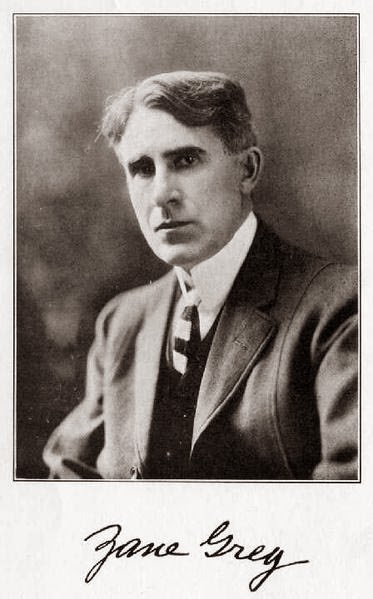
"The Zane family was a remarkable one in early days, and most of its members are historical characters." (Zane Grey, Betty Zane)
I never used to have much interest in the Western genre. However, since moving to California I have developed a taste for the novels of Zane Grey and Louis L'Amour and the movies of John Ford. I recently started re-reading Betty Zane, by Zane Grey. It isn't really a Western. There are no cowboys in it, although there are Indians. It's a historical novel set near the end of the American Revolution, in a frontier settlement on the Ohio River. Which I suppose makes it sort of a Western, as that was about as far west as you could get in those days—unless you were an Indian.
I have Betty Zane, along with many other books by Zane Grey, on my Kindle. Years ago, when I read it the first time, I did not have a Kindle. Nobody did. My father loaned me a worn, dog-eared paperback copy. He told me it was about some of our ancestors. He also told me it was out of print, and he wanted it back.
Dad's hobby was genealogy. Few things gave him as much pleasure as identifying a new branch on the family tree. In the beginning, he had to do his research by traveling to libraries in Indiana and neighboring states. As a child, I accompanied him on an overnight expedition to a library in eastern Ohio. I'm sure he was hoping that I would develop an interest in his hobby, and at first I found it exciting to be included on his quest. However, I soon became bored, and left him alone in the genealogy department to seek out the section of the library where the Hardy Boys could be found.
With the advent of the Internet, Dad suddenly had access to vast amounts of genealogical data, without leaving home. He quickly filled in more and more branches of both the Logue and Shorter—my mother's family—trees. (My mother was not amused when Dad discovered that the two of them were distant cousins.)
As I recall, it was shortly after Loretta and I moved to California that Dad discovered our family's connection to Zane Grey. We shared a common ancestor, described by Grey as "a Dane of aristocratic lineage, who was exiled from his country and came to America with William Penn. He was prominent for several years in the new settlement founded by Penn." However, "Being a proud and arrogant man, he soon became obnoxious to his Quaker brethren."
That obnoxious Quaker was one William Zane. His offspring included Betty (the heroine of Grey's novel), Ebenezer (Grey's ancestor), and Isaac (our ancestor).
When they were young, all of the Zane boys were kidnapped by Indians. Three of them, including Grey's ancestor Ebenezer, were ransomed. One was killed by his captors when he attempted to escape. The youngest, our ancestor Isaac, remained in captivity, held by bonds "stronger than those of interest or revenge such as had caused the captivity of his brothers. He was loved by an Indian princess, the daughter of Tarhe, the chief of the puissant Huron race." In the book Betty Zane—and in real life—Isaac Zane married that Indian princess, whose name was Myeerah.
Isaac and Myeerah were my father's great-great-great-great grandparents (give or take a "great").
My father was understandably excited to discover that we were distant cousins of Zane Grey, who practically invented the Cowboy (with a capital 'C') of American literature. He was even more excited that we were directly descended from a "chief of the puissant Huron race." When he told me the news in a telephone call, he announced that he was going to write to the current chief of the Wyandots and request membership for himself and my sister. He asked if I would be interested in joining as well.
"Are there any benefits?" I asked. "For instance, can I open a casino?"
I turned down my father's offer. He and my sister were dark enough to credibly claim a smidgen of Native American blood, whereas I inherited my mother's fair, northern European complexion.
I would have been laughed right out of the tribe.
![]() |
![]() |
(Many of Zane Grey's novels, including Betty Zane, are in the public domain and available as free downloads from Project Gutenberg.)
Tuesday, March 11, 2014
Where I Need to Be
Douglas Adams would have been sixty-two years old today, if he were still alive. Unfortunately, he died thirteen years ago, at the all-too-young age of forty-nine. (I judge anything younger than my current age as "all too young" and, to paraphrase Tom Lehrer, when Douglas Adams was my age he'd been dead for ten years.)
Adams was not a prolific writer, but what few works he left us were chock-full of some of the most brilliant, witty turns of phrase since Oscar Wilde and George Bernard Shaw. For instance, there's this gem from The Long Dark Tea-Time of the Soul:
"I may not have gone where I intended to go, but I think I have ended up where I needed to be."
It's a quotation that particularly resonates with me, for I have never been any good at making plans. I have always believed that, in the words of Robert Burns:
The best-laid schemes o' mice an' menWhich I took to be Scottish for "No matter what you do, you'll probably just end up getting eaten by a cat or caught in a mousetrap, so why bother?"
Gang aft agley,
An' lea'e us nought but grief an' pain,
For promis'd joy!
By my senior year in high school, I still had not figured out what I was going to do with my life. (I had barely figured out what I was doing in high school.) When forced to choose a career, I decided on the medical profession because I enjoyed biology class and I figured saving lives was a good thing to do. When forced to choose a college, I told the guidance counselor I would prefer a small southern school—small because my high school was enormous and I hated it, southern because my father's office would soon be relocating from Chicago, Illinois, to Parkersburg, West Virginia.
The guidance counselor came up with three small southern schools known for their pre-med programs. After looking at pictures of the three campuses, I chose Wake Forest University, in Winston-Salem, North Carolina, because I thought it had the most appealing architecture.
![]() |
| Wake Forest University |
I have always been partial to Georgian architecture.
I soon discovered that I could barely manage the biology courses required for a
pre-med degree, and I was completely hopeless at chemistry. I decided to leave Wake Forest and try to figure out something I could do with my life that did not involve atoms and valences.
Although I had not been at Wake Forest long, I had been there long enough to make a life-long friend. In H. David Hawthorne, I found a kindred spirit who shared my appreciation for theatre (with an 're'), British humour (with a 'u'), classical music, and beer (not necessarily in that order). Our friendship lasted from our freshman year at Wake Forest until Dave passed away eight years ago, at the all-too-young age of fifty.
About thirty years ago, Dave and his then-fiancee Claudia threw a party so that all of their friends could meet. At that party, I had the good fortune to be partnered with Claudia's pretty friend Loretta Wong in a game of Trivial Pursuit. Within a year, we were partnered again on the dance floor at Dave and Claudia's wedding. Within two more years, we were partnered for life.
I may not have gone where I intended to go in my life (or even known where that was), but, thanks to a random chain of events which began with a slight preference for Georgian architecture, I ended up exactly where I needed to be.
Which is wherever Loretta is.
Saturday, February 22, 2014
No Sweat
Thomas Alva Edison famously stated that "Genius is one percent inspiration and ninety-nine percent perspiration." (Which leads me to wonder if he invented antiperspirant, because he certainly must have needed it.)
It seems to me that the exact opposite of this formula applies to writing. (Which leads me to wonder if writers are the exact opposite of geniuses.)
Writing is nearly 100% inspiration. Without it you have nothing, and no amount of sweat is going to help. (In fact, if writing makes you sweat, you are doing it wrong. Either that, or you have a medical condition and should probably see a doctor.)
I had several ideas for today's post, none of which I found particularly inspiring. Here are a few of the best ones:
- How depressed would Dracula be if he saw a box of Count Chocula? Or, worse yet, the Twilight movies?
- What's the deal with memes? I don't see anything remotely funny about most of them. (Except for Lolcats. I love Lolcats.)
- Whatever happened to Charlie the Tuna? Did Starkist finally can him?
See what I mean?
Maybe I just need to take a break from this blog—at least until I think of something inspiring to write about. That may be a week from now—or it may be a month or even a year. Until then—
Don't panic.
Saturday, February 15, 2014
We All Live in a Yellow Mondegreen
I was nine years old when the Beatles made their historic appearance on The Ed Sullivan Show fifty years ago, and I missed it. I was watching part two of The Scarecrow of Romney Marsh on Disney's Wonderful World of Color (in black and white, as we did not have a color TV). At the time, I was more interested in Disney than rock and roll, but my tastes changed. I soon became a Beatles fan, as did everyone in my family, with the possible exception of my father. (I can't say that Dad, who preferred classical music, ever loved the Beatles, although he eventually grew to appreciate them.)
We had the first Capitol album (Meet the Beatles!) and we played it over and over again until we wore it out. I was envious of my friend Steve, who had all of the Capitol albums. My friends and I used to go to Steve's house, put the whole stack on his parents' state-of-the-art hi-fi, and jump around the living room, singing along with John, Paul, George, and Ringo. Singing along with the Beatles could be a challenge. It was sometimes difficult to understand what those four young Liverpudlians were singing, especially when they were trying to sound like Chuck Berry or Little Richard.
Speaking of Little Richard, his song Long Tall Sally, covered on the second Capitol album (imaginatively titled The Beatles' Second Album) was one of the songs that puzzled me most. What was it that Long Tall Sally had that Uncle John needed? Pretty good guitars? Pretty picture cards? Listening to the original Little Richard recording years later wasn't much help (although I did learn that surprisingly, in addition to being long and tall, Sally was also bald). But now, thanks to Google and the Internet, I can instantly look up the lyrics and discover that the mysterious line that troubled me all those years ago was—
Well Long Tall Sally's built pretty sweetWhen I was a kid, there was no Google or Internet. You couldn't look up lyrics. You just sang out and hoped that you would not embarrass yourself. In the song, It Won't Be Long, I always sang—
She got everything that Uncle John need
Every day we'll be happy I know—and no one corrected me. (The actual line, of course, is, "Now I know that you won't leave me no more.")
Now I know that you won't beat me no more
Misheard lyrics are known as "mondegreens"—a word coined by someone who misheard the lyric "laid him on the green" as "Lady Mondegreen." I learned about mondegreens about the same time I learned that the actual lyrics to She Loves You are—
You know it's up to youI always thought it was "The rightful thing to do / Apologize to her." It didn't seem right (or "rightful"), but it sort of made sense, and again, no one corrected me. Then, a few years ago, I heard Loretta singing the correct lyrics: "Pride can hurt you too." Boy, did I feel like a fool.
I think it's only fair
Pride can hurt you too
Apologize to her
Loretta is pretty good at understanding hard-to-understand lyrics, but she doesn't always get it right, either. I always thought the lyrics to I Want to Hold Your Hand were—
And when I touch you I feel happy inside.This time, it turns out I was right. Loretta thought that last line was "I get hives, I get hives, I get hives."
It's such a feeling that my love
I can't hide, I can't hide, I can't hide.
Saturday, February 8, 2014
Let the Games Begin
The Winter Olympics have started. Or should that be "has started?" Is "Olympics" singular or plural? You'd think, as an English major, I would know that.
I do know that I won't be watching.
I'd like to say it's in protest of Russia's anti-gay policies or generally bad record on human rights issues. I'd like to say that, but the fact is, I'm just not interested. Watching winter sports makes me cold. I moved to Southern California to get away from that sort of thing.
However, I did watch the beginning of last night's endless opening ceremony. Here are a few random thoughts:
Poor Bob Costas! What happened to his eye? I guess he didn't get the memo about the bad water.
![]() |
| Welcome to Sochi. Please don't drink—or touch—the water. |
The alphabet thing is nice. Do you suppose Putin realizes that Tchaikovsky was gay? And which Chekov are they talking about—the playwright or the guy on Star Trek?
At what point in the ceremony will Putin take his shirt off?
Didn't I see this in a Cirque du Soleil show? The flying islands are a nice effect. Are those real animals on top? I hope not, because if that horse or cow wanders too close to the edge, things could get ugly.
![]() |
| Cirque du Sochi |
Why can't they just fly that little girl over to the Olympic rings to fix that thing? She's already up there, and at this point, she's not doing much.
![]() |
| Hey, kid—fix that thing! |
Where can I get one of those light-up parkas? On second thought, something like that would be much too warm for Southern Califonia. How about a light-up hoodie?
Not only is Putin not shirtless, he's wearing a heavy winter coat—indoors. What a wuss.
![]() |
| Come on, Vladimir—take it off! |
I began to doze off during the Parade of Nations, so I missed the rest. Did he ever take his shirt off?
Saturday, February 1, 2014
Don't Laugh
For years we have been told (principally by Reader's Digest) that "laughter is the best medicine." However, I recently read about a scientific study in the British Medical Journal which suggests that this may not be true. I tried to read the study, but it was a bit too sciency for me. I suspect that it may in fact be an elaborate joke, but it's difficult to tell. I have the utmost respect for scientists, but they really shouldn't attempt humor. Have you ever heard a science joke? It's usually some variation on the old "walks into a bar" joke, featuring an element, a particle (Higgs boson is popular just now), or Schrödinger's cat. Even if you are able to comprehend it, it is almost never worth the effort, as it is hardly ever funny.
![]() |
| A Typical Science Joke (See what I mean?) |
As I was saying, I couldn't quite get through the study itself, but the article I read about the study included the following quote:
[L]aughter is no joke—dangers include syncope, cardiac and oesophageal rupture, and protrusion of abdominal hernias (from side splitting laughter or laughing fit to burst), asthma attacks, interlobular emphysema, cataplexy, headaches, jaw dislocation, and stress incontinence (from laughing like a drain). Infectious laughter can disseminate real infection, which is potentially preventable by laughing up your sleeve. As a side effect of our search for side effects, we also list pathological causes of laughter, among them epilepsy (gelastic seizures), cerebral tumours, Angelman’s syndrome, strokes, multiple sclerosis, and amyotrophic lateral sclerosis or motor neuron disease.I must confess that I have no idea what some of the above words mean, and I didn't bother to look them up. One of the words I did understand, however, was "syncope." It means "temporary loss of consciousness caused by a fall in blood pressure."
I know all about laughter and syncope.
Several years ago we were having dinner with Loretta's brother Rob and our niece Jenny in a very nice restaurant in Paris. (Actually we were at Epcot, but I have been to Paris, and frankly Epcot is just as nice—in many ways nicer.) Jenny is a scientist, and she is an exception to the rule about scientists' sense of humor. She doesn't tell jokes about Higgs boson or Schrödinger's cat. In fact, she often complains that other scientists don't understand her humor, which should give you an idea of how genuinely funny she is. She can always make me laugh—often at the most inappropriate times, such as when I am at a very nice restaurant in Paris (or Epcot) drinking a glass of fine French wine.
I don't remember what Jenny said on this particular occasion, but trust me, it was funny. I began to laugh. Then I began to cough. Fine French wine came out of my nose.
Everything went black.
When I came to, I was being pulled, prodded, and shaken by Loretta one one side and Rob on the other. Convinced that I was choking to death, the two of them were attempting to pull me out of my chair and administer the "hug of life." I was bruised and sore. I was disoriented. There was wine on the front of my shirt. Worst of all, everyone in the restaurant was looking at me.
"Someday," I thought, "this will probably be funny."
I was right, of course. It's funny now. But please don't laugh.
I wouldn't want you to hurt yourself.
Subscribe to:
Posts (Atom)


.png)