Showing posts with label internet. Show all posts

Saturday, November 21, 2015

My Childhood World


Our family moved a lot when my brother, my sister, and I were growing up. It was difficult for us, always having to leave friends behind and make new ones, but I'm grateful that we had the opportunity to be exposed to different places and people. It gave us a broader view of the world. Still, I sometimes wonder what life would have been like if we had stayed in one place. And the place I wonder most about is Warsaw, Indiana.

We lived there for only nine years—from when I was three years old to when I was twelve—but those were some of the most memorable years of my life. During that time, I began to make friends, I became a big brother (twice), and my world began to expand—from our little house and yard, out into our neighborhood and town.

The places I visited during that time are more strongly imprinted in my memory than any place I have visited since. I have often revisited them in dreams. I have even revisited them a time or two when I was awake (always furtively, like some creepy voyeur).

Then, a few years ago, I discovered Google Street View. At that time there were gaps; I found our house, but I could not explore beyond the end of our street. However, I went back last week, and I'm happy to report that my childhood world has now been completely mapped. I can now visit it at my leisure, any time I like, without leaving home. I spent some time there last weekend, and I think I'll go back today. Care to come along?

Here's our house—a typical post-WWII cracker box surrounded by other typical post-WWII cracker boxes:


We’re standing in the middle of North Harrison Street, facing east. (Don’t worry; there’s not much traffic. When I lived here, there was almost none.) That big tree in the yard? It wasn’t there when I lived here. Here’s what the house looked like in the summer of 1958, just after we moved in:


Turn left, and we’re looking north on Harrison Street:


The street was less than half a mile long when I lived here. Down at the north end there used to be a duck farm; now there's a hospital. There were no houses on the left side of the street when we moved in. Back then, there was nothing across the street but trees—a big, old, spooky woods (which my friends and I imaginatively referred to as “The Woods”). I still have nightmares about being lost in there at night.

Back then, there was only one house across the street from us:


You can’t see it, but it’s back there, behind the trees. It was decades old decades ago—the oldest house in the neighborhood, the only house in the woods—like something from the Brothers Grimm. This was the edge of town then, and living here was like living on the edge of a fairy tale—exciting and wonderful, but also scary. Our first winter here, the power went out and we had no heat. My dad went into the woods (at night!) with an ax to gather firewood. He got a fire going in the fireplace, and he, my mother (who was very pregnant with my sister), and I spent the night on the living-room sofa, snug and warm.

Turn left again and we’re facing south on Harrison:


This is the way I used to walk to school. It’s not far—less than half a mile. Let's go!


Harrison used to end here, at Sheridan Street. You had no choice but to make a right at the curve (which my friends and I imaginatively referred to as “The Curve”) and head west on Sheridan. Just two blocks west on Sheridan, and we're at Lincoln Street:


I did crossing guard duty on this corner. Once, some jerk almost killed me when I was riding my bike here. I was scared, but I was also furious. I knew I had the right-of-way, and I had used my hand signals, just as I had been taught in bicycle safety class. I learned a valuable lesson that day: just because you always obey the rules doesn't mean other people will.

One block south on Lincoln, and we’re at my old school, Lincoln Elementary:


It hasn’t changed much, except that the trees are bigger. Once, when I was in sixth grade, I stayed out all night with a couple of friends who, like me, were astronomy buffs. When we got bored looking at the stars and planets through my friend's telescope, we walked to the school and did a little trespassing: played on the playground equipment and even climbed up on the roof of the school. (I was quite the juvenile delinquent in those days.)

From here, it’s only about a mile to the center of town. Shall we go? It’s a longish walk, but when I was kid, I could get there on my bike in just a few minutes. We'll continue south on Lincoln for a block, turn right on Center, and head west:


"Center Plaza?" There was no "plaza" when I was a kid. When we moved to town, there was just a supermarket on this corner, then Judd Drugs opened next door. My friends and I spent a lot of time at Judd's: browsing through comic books, buying candy and soda pop. Judd's had to have been one of the last drug stores in the country to be built with a soda fountain. You could get a phosphate or a flavored Coke for just a nickel. (Does that make me sound old? Well, I am.) Looks like the only store left in this plaza that was here when I was a kid is the Ace Hardware. It opened just before we left town.

After traveling west on Center Street for about a mile, we're at Buffalo* Street:


To the right is the courthouse. The building on the left is now City Hall. It used to be a bank, and the offices of my dad's law firm used to be on the second floor: dark rooms with creaky floors and the intoxicating aroma of old books and pipe tobacco.

Turn right on Buffalo and halfway down the block, across from the courthouse, were two of my favorite places:
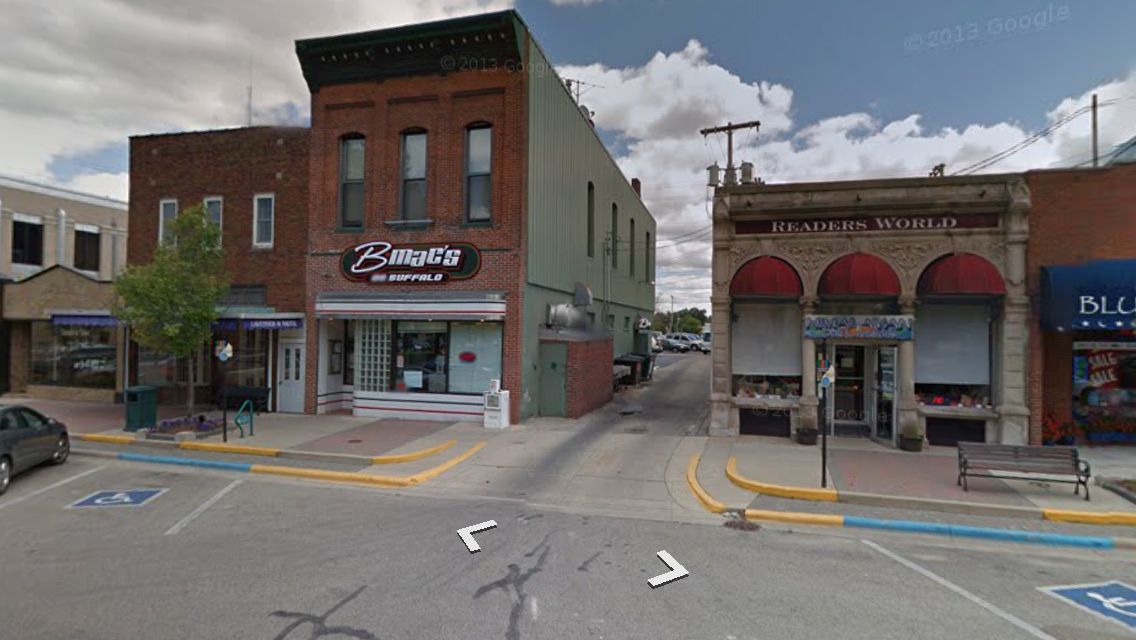

"Readers World” used to be called “ReadMore Books;” it was the first bookstore I ever visited, and it started a life-long love affair with bookstores. Unfortunately, according to an article I found online, Readers World closed its doors in 2010. The article stated that there had been "a newsstand/bookstore at that building on Buffalo Street since 1947." (Damn you, Amazon.)

The restaurant next door, "B-Macs," is still around. Back when I was a kid, it was the Humpty Dumpty Grill:


Nothing special: just a diner with a grill, counter and stools on one side and booths on the other. I loved to come here for lunch with my mother. She would order a hamburger, I would order a grilled cheese, and we would both order vanilla milkshakes. And as we ate our lunch, we would both admire the lifelike portraits of cowboys and Indians that covered the walls. The murals were the work of an artist named Fred Olds. It was obvious from his paintings that he loved the West. In 1962 he moved there, becoming artist-in-residence for the Oklahoma Historical Society. Unfortunately, no one thought to preserve the murals Fred painted on the walls of the Humpty Dumpty, but I did find this mural of the 1889 Land Run he painted for the Oklahoma Territorial Museum:


Continuing north to the next corner, we end our tour at one of my very favorite places. Here’s what the corner of Buffalo and Main looks like today:


At the end of Buffalo Street you can see Center Lake, where we went for swims and family picnics. In the winter, they used to put an old car out on the ice, and there was a contest to see who could come closest to guessing when it would fall through in the spring.

But it’s the building on the corner I’m talking about. It used to be the Lake Theater, where my dad took me to see Disney films starring Tommy Kirk or Hayley Mills (my first crush) and, when I was a little older, my friends and I went on our own to see the latest film starring Jerry Lewis or Elvis Presley, or (if we were feeling brave) a monster movie featuring an overgrown lizard or creature from outer space.

It makes me a little sad that the Lake Theater is gone. But at least the building is still there, and I can still picture it the way it was.

And that makes me happy.


Footnote

* In case you're wondering how a street in Warsaw, Indiana, came to be named "Buffalo," I found the following explanation on the Internet:
At this juncture the suggestion was made by one of the party that the young engineers who had rendered valuable services be accorded recognition by naming a street in complement to each of them. The names of the young men, however, could scarcely be called euphonious, and, as one of them is said to have remarked, were inappropriate for street nomenclature. The suggestion was therefore made that a street be named in honor of the home town of each. Thereupon Buffalo and Detroit streets came into being.
(How Warsaw Streets Got Their Names, Edwin C. Aborn, 1932.) I only wish Mr. Aborn had told us the name that was deemed "inappropriate for street nomenclature."

Saturday, October 24, 2015

Googling a Gaelic Ghost


As I mentioned earlier this month, among my favorite books for the Halloween season are two horror anthologies by Stephen Sutton: Tales to Tremble By and More Tales to Tremble By. After writing about these childhood favorites, I suddenly had the urge to read them again. I knew I had them somewhere, tucked among the hundreds of books in one of several bookcases in the house, or possibly in a box in the garage. I made a perfunctory search, but I was not able to find them. Even if I had been able to find them, since I have gotten used to reading on a Kindle, I no longer care to carry books around with me (especially books that are nearly as old and fragile as I am).

If only I could find TtTB and MTtTB in Kindle format.

Unfortunately, both books are out of print and will probably never be re-released—either for Kindle or in any other format. However, the stories in them were ancient when I first read them fifty years ago. If they weren't in the public domain then, they must be by now. Perhaps I could find them online and create my own Kindle book! I found lists of all the stories contained in each volume, and I began my search. Sure enough, within a week I had found every story but one: "The Suitor of Selkirk" by Anonymous.

Anonymous. Do you have any idea how difficult it is to find a story that has no author?

I considered giving up. After all, I had found most of the stories from TtTB and all of the stories from MTtTB. But I was obsessed. Who was this Suitor of Selkirk? The ghost of a star-crossed lover? The ghost of a petitioner in a lawsuit? I must have read the story as a child, but for the life of me I could not remember it, and I had to know.

I found one other reference to the story in a review of a 1935 horror anthology: More Great Tales of Horror, by Marjorie Bowen (aka Margaret Gabrielle Vere Campbell Long). Unfortunately, I could not find an electronic version of MGToH, either. However, the description of it told me that the story was originally from something called The Odd Volume. When I searched for "suitor of selkirk odd volume," Google informed me that it was also "Including results for sutor of selkirk odd volume." (This is why I use Google. Would Yahoo or Bing have gone that extra mile? I don't think so.)

I Googled the word "sutor" and found that it meant "a cobbler or shoemaker." By this time, I had also found my copy of TtTB. (It had been on a shelf not three feet from my head, hidden behind another row of books.) Sure enough, the story was actually titled "The Sutor of Selkirk," and was the account of a Scottish shoemaker's encounter with a mysterious customer. Someone had mistakenly corrected "sutor" to "suitor" in references to the contents of both TtTB and MGToH.

Once I had the spelling of "sutor" right, I immediately found the story posted on a site called Electric Scotland. That version had been scanned from an 1896 volume: The Book of Scottish Story. I also found it in an 1829 volume of The Edinburgh Literary Journal, scanned by Google Books. Both versions looked to be the same, and were considerably more Scottish than the version in TtTB. Somewhere along the way, someone had anglicized many of the more obscure expressions. (I suspect Marjorie Bowen, aka Margaret Gabrielle Vere Campbell Long. Anyone with that many names can't be trusted.)

For example, “He smells awfully o’ yird,” was changed to simply, “He smells awfully,” which gives the sentence a completely different meaning. It indicates the sutor's mysterious customer has an inferior sense of smell. (Which, come to think of it, he probably does, being dead.*

The complete story is below. I corrected a few typos and scan errors, but I left all of the Scottish expressions intact. You should be able to figure out their meaning from the context; if not, there's always Google. It's a fine ghost story full of wry gallows humor, and well worth the extra effort.

I will tell you this much: "yird" means "earth."

The Sutor of Selkirk: A Remarkably True Story

Once upon a time, there lived in Selkirk a shoemaker, by name Rabbie Heckspeckle, who was celebrated both for dexterity in his trade, and for some other qualifications of a less profitable nature. Rabbie was a thin, meagre-looking personage, with lank black hair, a cadaverous countenance, and a long, flexible, secret-smelling nose. In short, he was the Paul Pry of the town. Not an old wife in the parish could buy a new scarlet rokelay without Rabbie knowing within a groat of the cost; the doctor could not dine with the minister but Rabbie could tell whether sheep’s-head or haggis formed the staple commodity of the repast; and it was even said that he was acquainted with the grunt of every sow, and the cackle of every individual hen, in his neighbourhood; but this wants confirmation. His wife, Bridget, endeavoured to confine his excursive fancy, and to chain him down to his awl, reminding him it was all they had to depend on; but her interference met with exactly that degree of attention which husbands usually bestow on the advice tendered by their better halves—that is to say, Rabbie informed her that she knew nothing of the matter, that her understanding required stretching, and finally, that if she presumed to meddle in his affairs, he would be under the disagreeable necessity of giving her a top-dressing.

To secure the necessary leisure for his researches, Rabbie was in the habit of rising to his work long before the dawn; and he was one morning busily engaged putting the finishing stitches to a pair of shoes for the exciseman, when the door of his dwelling, which he thought was carefully fastened, was suddenly opened, and a tall figure, enveloped in a large black cloak, and with a broad-brimmed hat drawn over his brows, stalked into the shop. Rabbie stared at his visitor, wondering what could have occasioned this early call, and wondering still more that a stranger should have arrived in the town without his knowledge.

“You’re early afoot, sir,” quoth Rabbie. “Lucky Wakerife’s cock will no craw for a good half hour yet.”

The stranger vouchsafed no reply; but taking up one of the shoes Rabbie had just finished, deliberately put it on, and took a turn through the room to ascertain that it did not pinch his extremities. During these operations, Rabbie kept a watchful eye on his customer.

“He smells awfully o’ yird,” muttered Rabbie to himself; “ane would be ready to swear he had just cam frae the plough-tail.”

The stranger, who appeared to be satisfied with the effect of the experiment, motioned to Rabbie for the other shoe, and pulled out a purse for the purpose of paying for his purchase; but Rabbie’s surprise may be conceived, when, on looking at the purse, he perceived it to be spotted with a kind of earthy mould.

“Gudesake,” thought Rabbie, “this queer man maun hae howkit that purse out o’ the ground. I wonder where he got it. Some folk say there are bags o’ siller buried near this town.”

By this time the stranger had opened the purse, and as he did so, a toad and a beetle fell on the ground, and a large worm crawling out wound itself round his finger. Rabbie’s eyes widened; but the stranger, with an air of nonchalance, tendered him a piece of gold, and made signs for the other shoe.

“It’s a thing morally impossible,” responded Rabbie to this mute proposal. “Mair by token, that I hae as good as sworn to the exciseman to hae them ready by daylight, which will no be long o’ coming” (the stranger here looked anxiously towards the window); “and better, I tell you, to affront the king himsel, than the exciseman.”

The stranger gave a loud stamp with his shod foot, but Rabbie stuck to his point, offering, however, to have a pair ready for his new customer in twenty-four hours; and, as the stranger, justly enough perhaps, reasoned that half a pair of shoes was of as little use as half a pair of scissors, he found himself obliged to come to terms, and seating himself on Rabbie’s three-legged stool, held out his leg to the Sutor, who, kneeling down, took the foot of his taciturn customer on his knee, and proceeded to measure it.

“Something o’ the splay, I think, sir,” said Rabbie, with a knowing air.

No answer.

“Where will I bring the shoon to when they’re done?” asked Rabbie, anxious to find out the domicile of his visitor.

“I will call for them myself before cock crowing,” responded the stranger in a very uncommon and indescribable tone of voice.

“Hout, sir,” quoth Rabbie, “I canna let you hae the trouble o’ coming for them yoursel; it will just be a pleasure for me to call with them at your house.”

“I have my doubts of that,” replied the stranger, in the same peculiar manner; “and at all events, my house would not hold us both.”

“It maun he a dooms sma’ biggin,” answered Rabbie; “but noo that I hae ta’en your honour’s measure—”

“Take your own!” retorted the stranger, and giving Rabbie a touch with his foot that laid him prostrate, walked coolly out of the house.

This sudden overturn of himself and his plans for a few moments discomfited the Sutor; but quickly gathering up his legs, he rushed to the door, which he reached just as Lucky Wakerife’s cock proclaimed the dawn. Rabbie flow down the street, but all was still; then ran up the street, which was terminated by the churchyard, but saw only the moveless tombs looking cold and chill under the grey light of a winter morn. Rabbie hitched his red nightcap off his brow, and scratched his head with an air of perplexity.

“Weel” he muttered, as he retraced his steps homewards, “he has warred me this time, but sorrow take me if I’m no up wi’ him the morn.”

All day Rabbie, to the inexpressible surprise of his wife, remained as constantly on his three-legged stool as if he had been “yirked” there by some brother of the craft. For the space of twenty-four hours, his long nose was never seen to throw its shadow across the threshold of the door; and so extraordinary did this event appear, that the neighbours, one and all, agreed that it predicted some prodigy; but whether it was to take the shape of a comet, which would deluge them all with its fiery tail, or whether they were to be swallowed up by an earthquake, could by no means be settled to the satisfaction of the parties concerned.

Meanwhile, Rabbie diligently pursued his employment, unheeding the concerns of his neighbours. What mattered it to him, that Jenny Thrifty’s cow had calved, that the minister’s servant, with something in her apron, had been seen to go in twice to Lucky Wakerife’s, that the laird’s dairy-maid had been observed stealing up the red loan in the gloaming, that the drum had gone through the town announcing that a sheep was to be killed on Friday?—The stranger alone swam before his eyes; and cow, dairymaid, and drum kicked the beam. It was late in the night when Rabbie had accomplished his task, and then placing the shoes at his bedside, he lay down in his clothes, and fell asleep; but the fear of not being sufficiently alert for his new customer, induced him to rise a considerable time before daybreak. He opened the door and looked into the street, but it was still so dark he could scarcely see a yard before his nose; he therefore returned into the house, muttering to himself—“What the sorrow can keep him?” when a voice at his elbow suddenly said—

“Where are my shoes?”

“Here, sir,” said Rabbie, quite transported with joy; “here they are, right and tight, and mickle joy may ye hae in wearing them, for it’s better to wear shoon than sheets, as the auld saying gangs.”

“Perhaps I may wear both,” answered the stranger.

“Gude save us,” quoth Rabbie, “do ye sleep in your shoon?”

The stranger made no answer; but, laying a piece of gold on the table and taking up the shoes, walked out of the house.

“Now’s my time.” thought Rabbie to himself, as he slipped after him.

The stranger paced slowly on, and Rabbie carefully followed him; the stranger turned up the street, and the Sutor kept close to his heels. “’Odsake, where can he be gaun?” thought Rabbie, as he saw the stranger turn into the churchyard; “he’s making to that grave in the corner; now he’s standing still; now he’s sitting down. Gudesake! what’s come o’ him?” Rabbie rubbed his eyes, looked round in all directions, but, lo and behold! the stranger had vanished. “There’s something no canny about this,” thought the Sutor; “but I’ll mark the place at ony rate;” and Rabbie, after thrusting his awl into the grave, hastily returned home.

Shannon Stirnweis's illustration from TtTB
The news soon spread from house to house, and by the time the red-faced sun stared down on the town, the whole inhabitants were in commotion; and, after having held sundry consultations, it was resolved, nem. con., to proceed in a body to the churchyard, and open the grave which was suspected of being suspicious. The whole population of the Kirk Wynd turned out on this service. Sutors, wives, children, all hurried pell-mell after Rabbie, who led his myrmidons straight to the grave at which his mysterious customer had disappeared, and where he found his awl still sticking in the place where he had left it. Immediately all hands went to work; the grave was opened; the lid was forced off the coffin; and a corpse was discovered dressed in the vestments of the tomb, but with a pair of perfectly new shoes upon its long bony feet. At this dreadful sight the multitude fled in every direction, Lucky Wakerife leading the van, leaving Rabbie and a few bold brothers of the craft to arrange matters as they pleased with the peripatetic skeleton. A council was held, and it was agreed that the coffin should be firmly nailed up and committed to the earth. Before doing so, however, Rabbie proposed denuding his customer of his shoes, remarking that he had no more need for them than a cart had for three wheels. No objections were made to this proposal, and Rabbie, therefore, quickly coming to extremities, whipped them off in a trice. They then drove half a hundred tenpenny nails into the lid of the coffin, and having taken care to cover the grave with pretty thick divots, the party returned to their separate places of abode.

Certain qualms of conscience, however, now arose in Rabbie’s mind as to the propriety of depriving the corpse of what had been honestly bought and paid for. He could not help allowing, that if the ghost were troubled with cold feet, a circumstance by no means improbable, he might naturally wish to remedy the evil. But, at the same time, considering that the fact of his having made a pair of shoes for a defunct man would be an everlasting blot on the Heckspeckle escutcheon, and reflecting also that his customer, being dead in law, could not apply to any court for redress, our Sutor manfully resolved to abide by the consequences of his deed.

Next morning, according to custom, he rose long before day, and fell to his work, shouting the old song of the “Sutors of Selkirk” at the very top of his voice. A short time, however, before the dawn, his wife, who was in bed in the back room, remarked, that in the very middle of his favourite verse, his voice fell into a quaver; then broke out into a yell of terror; and then she heard a noise, as of persons struggling; and then all was quiet as the grave. The good dame immediately huddled on her clothes, and ran into the shop, where she found the three-legged stool broken in pieces, the floor strewed with bristles, the door wide open, and Rabbie away! Bridget rushed to the door, and there she immediately discovered the marks of footsteps deeply printed on the ground. Anxiously tracing them, on—and on—and on— what was her horror to find that they terminated in the churchyard, at the grave of Rabbie’s customer! The earth round the grave bore traces of having been the scene of some fearful struggle, and several locks of lank black hair were scattered on the grass. Half distracted, she rushed through the town to communicate the dreadful intelligence. A crowd collected, and a cry speedily arose to open the grave. Spades, pickaxes, and mattocks, were quickly put in requisition; the divots were removed; the lid of the coffin was once more torn off, and there lay its ghastly tenant, with his shoes replaced on his feet, and Rabbie’s red night-cap clutched in his right hand!

The people, in consternation, fled from the churchyard; and nothing further has ever transpired to throw any additional light upon the melancholy fate of the Sutor of Selkirk.

Footnote

* Sorry, I probably should have included a spoiler alert there. ("Spoiler alert." That's actually pretty funny. Get it? Spoiler alert? Because he's dead? Never mind. Sorry I brought it up.)

Saturday, July 4, 2015

Is it true? Is it necessary? Is it kind?


For approximately twenty-four hours following last week's historic Supreme Court decision of Obergefell v. Hodges, I saw nothing but joy on the Internet. My Facebook feed was filled with rainbows and "LoveWins" hashtags. (I must admit that I still don't fully understand hashtags, but I could appreciate the sentiment.)

Then the backlash started. It ranged from disapproving but forgiving ("Jesus still loves you, even though you are a sinner") to downright hateful ("You are going to burn in hell, and I would be happy to supply the match").

I am not a theologian, and I will not presume to tell you what the Bible says or does not say about homosexuality. (There are plenty of other people on the Internet who will be more than happy to do that.) I do know that Jesus had a lot to say about tolerance and forgiveness. And the one thing he said that he particularly wanted his followers to remember was that bit about "loving thy neighbor as thyself."

I am not a Buddhist, either, but one of my favorite quotes, which I came across for the first time on the Internet a few years ago, is this one:
"If you propose to speak, always ask yourself, is it true, is it necessary, is it kind."— Buddha
An excellent rule, particularly in these days when everyone feels free to express whatever they like on the Internet, regardless of how it may affect others.

1. Is it true?

Before posting anything, it should go without saying that you should make sure it is true. Don't take the word of one source. Google it, and see what other people have to say about it. For instance, I Googled the above quote and found that Buddha never said it. It was actually some guy named Bernard Meltzer, and what he actually said was, "Before you speak ask yourself if what you are going to say is true, is kind, is necessary, is helpful. If the answer is no, maybe what you are about to say should be left unsaid." (Which in my opinion is just as good, though somewhat less succinct.)


2. Is it necessary?

Let's face it, nearly everything that is posted on the Internet is unnecessary. Unless you are posting a warning about an imminent tornado, earthquake, flood, fire, locust swarm, etc., the world can do without your post. However, if it passes the next test, I would say go ahead. I fully intend to post this, although, like everything else I have ever posted, it is completely unnecessary, and will only be read by a handful of people (at least a few of which, according to my Blogger stats, are in Russia).

3. Is it kind (and/or helpful)?

You don't need Google for this, just a little empathy. Try to put yourself in the position of your readers. Ask yourself, "How would I feel if I were [gay, straight, conservative, liberal, black, white, Christian, Muslim, etc.], and I read this post? Would I feel it was kind? Would I feel it was helpful? How would it make me feel?"

If it's not true, not necessary, not kind or helpfulthen why on earth would you want to post it?

If you are American, have a safe and happy Fourth! And please remember that our Founding Fathers believed that we were all created equal, all of us with the same unalienable rights to life, liberty, and the pursuit of happiness.

And if you are Russian, "Dobraye ootro!"