Showing posts with label history. Show all posts

Saturday, April 6, 2019

Nothing Is Forever


It's National Poetry Month, and I have spent the week racking (or is it "wracking?") my brain and the internet for a poem to express my feelings about these "interesting times" we live in. I finally thought of Percy Bysshe Shelley's "Ozymandias," but when I searched for the poem, I discovered that there are, in fact, two "Ozymandiases" ("Ozymandii?")—one written by Shelley, the other by his friend and fellow poet, Horace Smith. Here are both poems:

Ozymandias
by Percy Bysshe Shelley

I met a traveller from an antique land
Who said: Two vast and trunkless legs of stone
Stand in the desert... near them, on the sand,
Half sunk, a shattered visage lies, whose frown,
And wrinkled lip, and sneer of cold command,
Tell that its sculptor well those passions read
Which yet survive, stamped on these lifeless things,
The hand that mocked them and the heart that fed;
And on the pedestal these words appear:
'My name is Ozymandias, king of kings;
Look on my works, ye Mighty, and despair!'
Nothing beside remains. Round the decay
Of that colossal wreck, boundless and bare
The lone and level sands stretch far away.

Ozymandias (aka "On a Stupendous Leg of Granite, Discovered Standing by Itself in the Deserts of Egypt, with the Inscription Inserted Below"*)
by Horace Smith

In Egypt's sandy silence, all alone,
Stands a gigantic Leg, which far off throws
The only shadow that the Desert knows:—
"I am great OZYMANDIAS," saith the stone,
"The King of Kings; this mighty City shows
"The wonders of my hand."— The City's gone,—
Naught but the Leg remaining to disclose
The site of this forgotten Babylon.
We wonder,—and some Hunter may express
Wonder like ours, when thro' the wilderness
Where London stood, holding the Wolf in chace,
He meets some fragment huge, and stops to guess
What powerful but unrecorded race
Once dwelt in that annihilated place.

According to Wikipedia, both poems were likely inspired by "the announcement of the British Museum's acquisition of a large fragment of a statue of Ramesses II..." You may remember Ramesses (or "Ramses") as the pharaoh of Exodus, portrayed by Yul Brynner in "The Ten Commandments." "Ozymandias" is what the Greeks called him, and if the Greeks wrote about him—well, in those days, that pretty much meant he was world famous. He was the most powerful and longest-reigning pharaoh in Egypt's history—not to mention the most egotistical. He ordered the construction of numerous temples and palaces bearing his name, and the erection of enormous statues bearing his image.

Statue Fragment in British Museum

You know how some people think they are "God's Gift?" Well, this guy thought he was a god—literally. Yes, I know the word "literally" is used far too frequently and generally incorrectly, but as an English major, I know the time and place to use it, and this is one of those times and places. Ramesses believed himself to be literally immortal.

He was wrong, of course, and that's what both "Ozymandias" poems are about.

Nothing is forever.

And these days, that's a very comforting thought.


*Smith changed his poem's title to avoid confusion with Shelley's, which may have something to do with it's having been all but forgotten. "On a Stupendous Leg of Granite, Discovered Standing by Itself in the Deserts of Egypt, with the Inscription Inserted Below," does not exactly roll off the tongue, nor is it an easy title to remember.

Saturday, November 7, 2015

A Colossal Waste of Time


This thing all things devours:
Birds, beasts, trees, flowers;
Gnaws iron, bites steel;
Grinds hard stones to meal;
Slays king, ruins town,
And beats high mountain down.

As the above riddle from J.R.R. Tolkien's The Hobbit attests, time is a terrible thing. And as if it weren't bad enough, we humans have contrived a way to make it worse. Last weekend was the end of daylight saving time for most of us here in the United States.* In our house, that meant resetting a dozen or so different clocks and timers—most of which are digital, each of which must be set by using a different sequence of buttons, none of which sequences we can ever remember from one time change to the next.

What a colossal waste of time.

Why do we even have daylight saving time? Some people think it has something to do with farmers, but the truth is that farmers have historically opposed it. Some credit (or blame) Benjamin Franklin, but he had nothing to do with it either. No, according to Wikipedia, the person who originally came up with the brilliant idea of resetting our clocks twice a year, needlessly complicating our lives and disrupting our sleep patterns, was one George V. Hudson, a New Zealand entomologist who proposed it solely so that he could have another hour or two of daylight at the end of the day to collect specimens.

The bloody selfish bug-loving bastard.

Trust me, I am not the only person who thinks the idea is idiotic. Every year, reasonable people question why we continue to torture ourselves with DST. Some advocate eliminating it. Others would like to see us stay on DST year-round. (We might as well; we are now on it for two-thirds of the year.) I would be happy either way, but I don't foresee a change in my lifetime.

Because, believe it or not, there are some people who like daylight saving time—and not just because of that extra hour of afternoon daylight in the summer. They look forward to setting their clocks back in the fall, because they think this gives them an extra hour of sleep. Fools! All you are getting is the same hour back that was taken away from you eight months ago, and most of that hour is wasted resetting clocks! And you aren't even getting interest for that hour! I calculate, at a modest rate of 1%, we should be getting at least sixteen additional minutes of sleep when we "fall back."

Personally, I don't get any extra sleep. If anything, I get less. This is because, unlike the dozen or so clocks and timers in our house, my body's internal clock cannot simply be reset with a button or two. It takes days to adjust. Here it is a week later, and I am still waking up and falling asleep at the same time I woke up and fell asleep last week—except now that time is an hour earlier. I feel tired and out of sync. I'm useless at work. (At least that much hasn't changed.) To me, daylight saving time is like a bad case of jet lag without any jet.

Animals understand this—or rather, they don't. We have two cats and two rabbits in our house, and I can attest to the fact that not one of them understands the concept of daylight saving time. They expect us to get up and go to bed—and, most importantly, to feed them—at the same time we did last week. They live their lives according to their internal clocks, with no regard whatsoever for the dozen or so clocks and timers in our house.

I can't wait until I can retire and do the same.

Real rabbits never do this.

Footnote

* A couple of states have had the good sense to reject daylight saving time. My home state of Indiana used to be one of them, until they gave in and adopted it in 2006. (Really, Indiana? If the rest of the states jumped off a bridge, would you do it too?)

Saturday, May 31, 2014

Cowboys and Indians


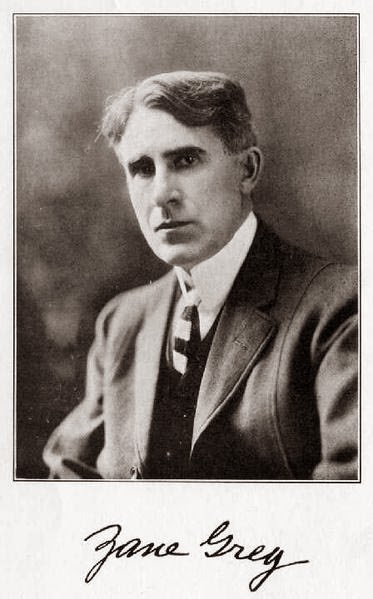
"The Zane family was a remarkable one in early days, and most of its members are historical characters." (Zane Grey, Betty Zane)

I never used to have much interest in the Western genre. However, since moving to California I have developed a taste for the novels of Zane Grey and Louis L'Amour and the movies of John Ford. I recently started re-reading Betty Zane, by Zane Grey. It isn't really a Western. There are no cowboys in it, although there are Indians. It's a historical novel set near the end of the American Revolution, in a frontier settlement on the Ohio River. Which I suppose makes it sort of a Western, as that was about as far west as you could get in those days—unless you were an Indian.

I have Betty Zane, along with many other books by Zane Grey, on my Kindle. Years ago, when I read it the first time, I did not have a Kindle. Nobody did. My father loaned me a worn, dog-eared paperback copy. He told me it was about some of our ancestors. He also told me it was out of print, and he wanted it back.

Dad's hobby was genealogy. Few things gave him as much pleasure as identifying a new branch on the family tree. In the beginning, he had to do his research by traveling to libraries in Indiana and neighboring states. As a child, I accompanied him on an overnight expedition to a library in eastern Ohio. I'm sure he was hoping that I would develop an interest in his hobby, and at first I found it exciting to be included on his quest. However, I soon became bored, and left him alone in the genealogy department to seek out the section of the library where the Hardy Boys could be found.

With the advent of the Internet, Dad suddenly had access to vast amounts of genealogical data, without leaving home. He quickly filled in more and more branches of both the Logue and Shorter—my mother's family—trees. (My mother was not amused when Dad discovered that the two of them were distant cousins.)

As I recall, it was shortly after Loretta and I moved to California that Dad discovered our family's connection to Zane Grey. We shared a common ancestor, described by Grey as "a Dane of aristocratic lineage, who was exiled from his country and came to America with William Penn. He was prominent for several years in the new settlement founded by Penn." However, "Being a proud and arrogant man, he soon became obnoxious to his Quaker brethren."

That obnoxious Quaker was one William Zane. His offspring included Betty (the heroine of Grey's novel), Ebenezer (Grey's ancestor), and Isaac (our ancestor).

When they were young, all of the Zane boys were kidnapped by Indians. Three of them, including Grey's ancestor Ebenezer, were ransomed. One was killed by his captors when he attempted to escape. The youngest, our ancestor Isaac, remained in captivity, held by bonds "stronger than those of interest or revenge such as had caused the captivity of his brothers. He was loved by an Indian princess, the daughter of Tarhe, the chief of the puissant Huron race." In the book Betty Zane—and in real life—Isaac Zane married that Indian princess, whose name was Myeerah.

Isaac and Myeerah were my father's great-great-great-great grandparents (give or take a "great").

My father was understandably excited to discover that we were distant cousins of Zane Grey, who practically invented the Cowboy (with a capital 'C') of American literature. He was even more excited that we were directly descended from a "chief of the puissant Huron race." When he told me the news in a telephone call, he announced that he was going to write to the current chief of the Wyandots and request membership for himself and my sister. He asked if I would be interested in joining as well.

"Are there any benefits?" I asked. "For instance, can I open a casino?"

I turned down my father's offer. He and my sister were dark enough to credibly claim a smidgen of Native American blood, whereas I inherited my mother's fair, northern European complexion.

I would have been laughed right out of the tribe.

http://en.wikipedia.org/wiki/Zane_Grey http://en.wikipedia.org/wiki/Tarhe

(Many of Zane Grey's novels, including Betty Zane, are in the public domain and available as free downloads from Project Gutenberg.)

Saturday, October 5, 2013

The Ruins of Pompeii


In Napoli, where love is king,
When boy meets girl here's what they say—
When the moon hits your eye like a big pizza pie
That's amore!
We had hoped to sample a big pizza pie in Naples, the fifth port of call on our Mediterranean cruise, but there just wasn't time. We had to see The Ruins of Pompeii. Here's the description from the brochure:
From the pier, it’s a 45-minute ride by motor coach to the remarkable ruins of Pompeii, perfectly preserved since the eruption of Mt Vesuvius in AD 79. On a guided walking tour you will learn about the excavation techniques that have uncovered this city remarkably intact and what the residents were doing at the time of the eruption. You'll gain an insight into the lives of the ancient Romans as you discover baths, theatres, temples, markets and the huge forum.
Not surprisingly, a lot of people on the ship wanted to see Pompeii, and multiple buses were required. Susan and Kevin were assigned to a different tour than ours. Our guide's name was Massimo. As we set out, he pointed out Mount Vesuvius and explained that it was dormant, but not extinct. He said that it probably would not erupt today, but if by chance it did, we were welcome to join him in running a brisk half-marathon back to the ship.

Mark Twain visited Pompeii in 1867. (You can read his account here.) Little has changed since he was there—including what he refers to as "the only building in Pompeii which no woman is now allowed to enter." Women are allowed to enter it today, of course, and it is one of the most popular attractions in Pompeii. Susan and Kevin's group saw it. Our group didn't, but Massimo told us about it: the sailors who frequented it, the "friendly girls" who worked there, and the naughty illustrations that still adorn its walls.

What we did see was what was left of the baths, a typical house, the temple of Apollo, and several bakeries and restaurants. Massimo kept us moving. Whenever another tour was about to overtake us, he would exclaim, "Andiamo! We are being invaded again!" and off we'd go.

Massimo

And then we came to the bodies.

At the show that evening, Garrison jokingly boasted that he did not go to Pompeii. He accused those of us who did (including his wife) of having a ghoulish interest in dead bodies. I suppose there may be something to that. When our group came to the glass cases holding the bodies (actually plaster casts of bodies, but here and there you could see a bone peeking through), we were all drawn to them like moths to a flame. What was fascinating, horrifying, and heartbreaking about them was that, from their poses, you could see the surprise and terror in which they died.

Victims of Vesuvius

But to me the most interesting thing about Pompeii is not seeing how the people died; it's seeing how they lived: their houses, temples, businesses, streets, and elaborate plumbing and drainage system. Their engineering was remarkably sophisticated. Unfortunately, Massimo told us, their lives were shortened by the toxic lead they used for just about everything; it can be found in the paint, the mortar between the stones, and, most unfortunately, the plumbing. This was probably their second biggest mistake. (Their biggest mistake, of course, was building their city beneath a volcano.)

Vesuvius and the Ruins of Pompeii

That night, the captain announced that we would be passing by an active volcano—Stromboli—and if we got up early, we might see an eruption. We set our alarms, and at five a.m. we stumbled out of bed, threw on some clothes, and made our way up to the bow of the ship. Ahead of us we could barely see the outline of a mountain against the dark sky, with a dim orange glow at its peak. We all stared at it for several minutes. I believe everyone was thinking of Mount Vesuvius and its victims. I know I was.

That morning we squeezed past Sicily through the Strait of Messina, rounded the toe of Italy's boot, and headed north toward the Adriatic Sea. This was our "at sea" day, and I planned to spend most of it sipping mimosas (for the vitamin C) and napping. I had returned from Pompeii with a hacking cough, and now I had developed a runny nose. Clearly, I had picked up a virus, but it was only a cough and sniffles. It could be a lot worse, right?

As it turned out, it was.

Saturday, March 30, 2013

Isaac Newton Was a Bully


Yesterday, as so often happens when I'm looking up something on the Internet, I stumbled across something wholly unrelated and infinitely more interesting, causing me to completely forget what I was originally looking for. It was a list Sir Isaac Newton made of "sins" he committed in 1662, when he was young and full of beans, and had yet to discover gravity or invent the pet door.

I won't list them all, but here are some of the juiciest:
Making pies on Sunday night
Putting a pin in Iohn Keys hat on Thy day to pick him
Threatning my father and mother Smith to burne them and the house over them
Wishing death and hoping it to some
Striking many
Having uncleane thoughts words and actions and dreamese
Punching my sister
Calling Dorothy Rose a jade
Peevishness with my mother
Falling out with the servants
Beating Arthur Storer
Peevishness at Master Clarks for a piece of bread and butter
Striving to cheat with a brass halfe crowne
Twisting a cord on Sunday morning
Vsing Wilfords towel to spare my own
Lying about a louse
Denying my chamberfellow of the knowledge of him that took him for a sot

I grant you that most of the above transgressions seem pretty tame by today's standards. For instance, who among us has not lied about a louse or denied our chamberfellow of the knowledge of him that took him for a sot? And, let's face it, Dorothy Rose is a jade, and everyone knows it.

However, a number of items on the list are seriously disturbing. They paint the extremely unflattering portrait of an obnoxious jerk who punched his sister, beat one guy, stuck a pin in another, wished and hoped death to some, struck many, and threatened to burn his parents' house down with them in it.

In short, Sir Isaac Newton was a bully with a streak of cruelty to rival that of the Marquis de Sade. And if any further proof were needed of that fact, I remind you that this is also the man who invented calculus.

Q.E.D.

Saturday, December 8, 2012

Who's a Hoosier?


Last week, in honor of the Tony Award-winning production of Anything Goes currently playing at the Ahmanson (which we're seeing tomorrow), the L.A. Times ran a quiz about Cole Porter. I like to flatter myself that I know something about the man. After all, we both came from Indiana.

It turns out the only thing I knew about Cole Porter was that he came from Indiana.

If there's one thing we Hoosiers know, it's who else is a Hoosier. (If there's one thing we don't know, it's where the word "Hoosier" comes from. There are many and widely-divergent theories, including: a corruption of the word "hussar," a corruption of the French word for "bailiff," and—strangest of all considering there are few hills in Indiana—a corruption of an Anglo-Saxon word meaning "hill people." The only thing everyone can agree on is that it's a corruption of something.)

Besides songwriter Cole Porter, there have been many other talented Hoosiers, including fellow songwriters Hoagy Carmichael and John Mellencamp, writers Rex Stout and Kurt Vonnegut, Jr., and actors James Dean and Carole Lombard.

Comedian Red Skelton was a Hoosier, as was David Letterman, who was born in Indianapolis and went to college in Muncie, at Ball State. (Go ahead and laugh.)

Michael Jackson's entire family were Hoosiers, but Wilbur was the only Hoosier Wright Brother. (Orville was born in Ohio.) Abraham Lincoln grew up in Indiana, but he doesn't qualify; he was born in Kentucky.

Clothing designer Bill Blass was from Fort Wayne. He went to the same high school as my parents, uncles, and aunts.

Basketball star Larry Bird was from French Lick. (Go ahead and laugh.)

James Whitcomb Riley, from Greenfield, Indiana, was known as "The Hoosier Poet." He wrote:
When the frost is on the punkin and the fodder’s in the shock,
And you hear the kyouck and gobble of the struttin’ turkey-cock,
And the clackin’ of the guineys, and the cluckin’ of the hens,
And the rooster’s hallylooyer as he tiptoes on the fence...
I have no idea what a "kyouck" or "hallylooyer" is, but this, supposedly, is the way Hoosiers used to talk.

Which could explain the word "Hoosier."

Saturday, September 15, 2012

A Good Villain Is Hard to Find


My conscience hath a thousand several tongues,
And every tongue brings in a several tale,
And every tale condemns me for a villain.

—Shakespeare, The Tragedy of Richard the Third

This week I read in a BBC news story that British archaeologists believe they may have found the remains of King Richard III. They're pretty excited about it. A member of the Richard III Society was quoted as saying, "It is such a tumult of emotions... I just feel happy and sad and excited all at the same time. It is very odd." Odd indeed. First of all, I had no idea Richard III was missing. It seems pretty careless of the English to misplace one of their kings like that. Second—

There's a Richard III Society?

I looked it up. It was founded in 1924 with the goal of setting the record straight about one of England's most misunderstood monarchs. Apparently there is no evidence whatsoever that he was the hunchbacked villain portrayed by Shakespeare, no evidence whatsoever that he systematically murdered members of his own family to get at the crown. Apparently he was just a regular guy (well, regular king) with a touch of scoliosis who was the innocent victim of a vicious slander campaign.

This is so wrong.

The world needs good villains. What good is a hero without one? What would Superman be without Lex Luthor? What would Dorothy be without the Wicked Witch? What would Luke Skywalker be without Darth Vader? (I mean, of course, apart from the obvious fact that he'd never have been born.) What would all of those Disney princesses be without their respective wicked stepmothers?

The answer, of course, is "nothing."

Come to think of it, who needs a hero? There's no hero in Shakespeare's Tragedy of Richard the Third. There is only Richard—one of the greatest villains of all time.

Every actor worth his salt wants to play Richard. Or her salt. In 2003, Loretta and I were fortunate enough to attend a historic all-female production of Richard III at Shakespeare's Globe in London. Kathryn Hunter was simply brilliant as Richard. As one reviewer put it, "Miss Hunter makes a superbly evil King with a wry sense of humour and her gender is never an issue."

That's what's made Richard so appealing to actors and audiences for nearly four hundred years—that perfect combination of superb evil and sly humor.

So please, please, please stop trying to rehabilitate my favorite villain. I'd hate to see him relegated to the status of an ordinary king. I'd much prefer to remember him as Shakespeare's "poisonous bunchback'd toad," with a sense of morality—and humor—as twisted as his spine.

What's more, I think he would prefer it, too.


"A murderous villain, and so still thou art."