Showing posts with label Indiana. Show all posts

Saturday, November 21, 2015

My Childhood World


Our family moved a lot when my brother, my sister, and I were growing up. It was difficult for us, always having to leave friends behind and make new ones, but I'm grateful that we had the opportunity to be exposed to different places and people. It gave us a broader view of the world. Still, I sometimes wonder what life would have been like if we had stayed in one place. And the place I wonder most about is Warsaw, Indiana.

We lived there for only nine years—from when I was three years old to when I was twelve—but those were some of the most memorable years of my life. During that time, I began to make friends, I became a big brother (twice), and my world began to expand—from our little house and yard, out into our neighborhood and town.

The places I visited during that time are more strongly imprinted in my memory than any place I have visited since. I have often revisited them in dreams. I have even revisited them a time or two when I was awake (always furtively, like some creepy voyeur).

Then, a few years ago, I discovered Google Street View. At that time there were gaps; I found our house, but I could not explore beyond the end of our street. However, I went back last week, and I'm happy to report that my childhood world has now been completely mapped. I can now visit it at my leisure, any time I like, without leaving home. I spent some time there last weekend, and I think I'll go back today. Care to come along?

Here's our house—a typical post-WWII cracker box surrounded by other typical post-WWII cracker boxes:


We’re standing in the middle of North Harrison Street, facing east. (Don’t worry; there’s not much traffic. When I lived here, there was almost none.) That big tree in the yard? It wasn’t there when I lived here. Here’s what the house looked like in the summer of 1958, just after we moved in:


Turn left, and we’re looking north on Harrison Street:


The street was less than half a mile long when I lived here. Down at the north end there used to be a duck farm; now there's a hospital. There were no houses on the left side of the street when we moved in. Back then, there was nothing across the street but trees—a big, old, spooky woods (which my friends and I imaginatively referred to as “The Woods”). I still have nightmares about being lost in there at night.

Back then, there was only one house across the street from us:


You can’t see it, but it’s back there, behind the trees. It was decades old decades ago—the oldest house in the neighborhood, the only house in the woods—like something from the Brothers Grimm. This was the edge of town then, and living here was like living on the edge of a fairy tale—exciting and wonderful, but also scary. Our first winter here, the power went out and we had no heat. My dad went into the woods (at night!) with an ax to gather firewood. He got a fire going in the fireplace, and he, my mother (who was very pregnant with my sister), and I spent the night on the living-room sofa, snug and warm.

Turn left again and we’re facing south on Harrison:


This is the way I used to walk to school. It’s not far—less than half a mile. Let's go!


Harrison used to end here, at Sheridan Street. You had no choice but to make a right at the curve (which my friends and I imaginatively referred to as “The Curve”) and head west on Sheridan. Just two blocks west on Sheridan, and we're at Lincoln Street:


I did crossing guard duty on this corner. Once, some jerk almost killed me when I was riding my bike here. I was scared, but I was also furious. I knew I had the right-of-way, and I had used my hand signals, just as I had been taught in bicycle safety class. I learned a valuable lesson that day: just because you always obey the rules doesn't mean other people will.

One block south on Lincoln, and we’re at my old school, Lincoln Elementary:


It hasn’t changed much, except that the trees are bigger. Once, when I was in sixth grade, I stayed out all night with a couple of friends who, like me, were astronomy buffs. When we got bored looking at the stars and planets through my friend's telescope, we walked to the school and did a little trespassing: played on the playground equipment and even climbed up on the roof of the school. (I was quite the juvenile delinquent in those days.)

From here, it’s only about a mile to the center of town. Shall we go? It’s a longish walk, but when I was kid, I could get there on my bike in just a few minutes. We'll continue south on Lincoln for a block, turn right on Center, and head west:


"Center Plaza?" There was no "plaza" when I was a kid. When we moved to town, there was just a supermarket on this corner, then Judd Drugs opened next door. My friends and I spent a lot of time at Judd's: browsing through comic books, buying candy and soda pop. Judd's had to have been one of the last drug stores in the country to be built with a soda fountain. You could get a phosphate or a flavored Coke for just a nickel. (Does that make me sound old? Well, I am.) Looks like the only store left in this plaza that was here when I was a kid is the Ace Hardware. It opened just before we left town.

After traveling west on Center Street for about a mile, we're at Buffalo* Street:


To the right is the courthouse. The building on the left is now City Hall. It used to be a bank, and the offices of my dad's law firm used to be on the second floor: dark rooms with creaky floors and the intoxicating aroma of old books and pipe tobacco.

Turn right on Buffalo and halfway down the block, across from the courthouse, were two of my favorite places:
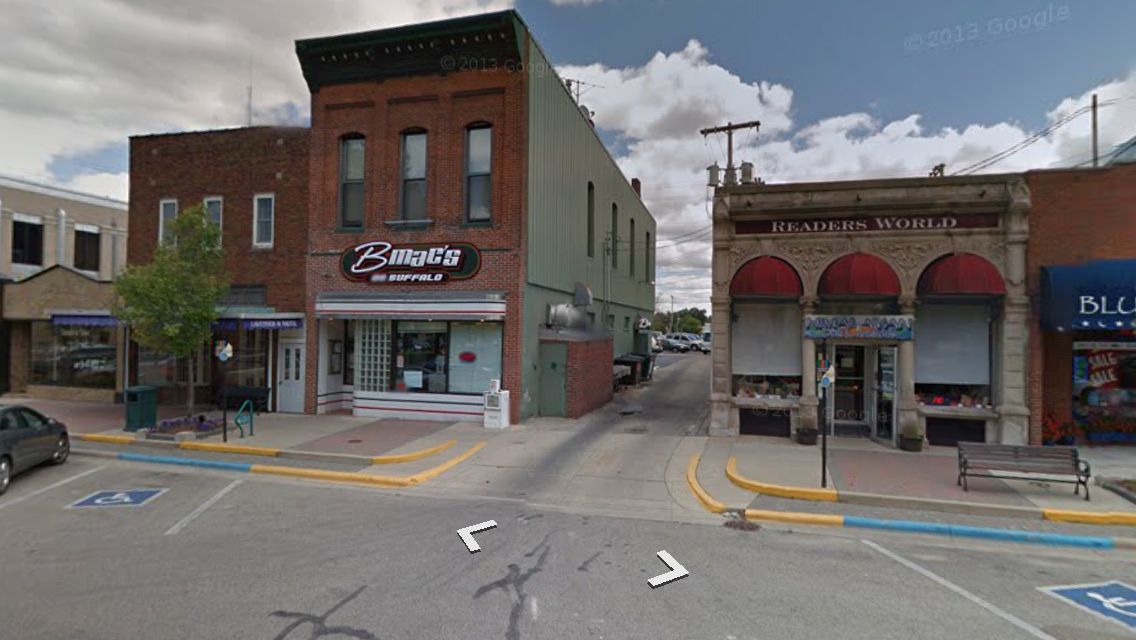

"Readers World” used to be called “ReadMore Books;” it was the first bookstore I ever visited, and it started a life-long love affair with bookstores. Unfortunately, according to an article I found online, Readers World closed its doors in 2010. The article stated that there had been "a newsstand/bookstore at that building on Buffalo Street since 1947." (Damn you, Amazon.)

The restaurant next door, "B-Macs," is still around. Back when I was a kid, it was the Humpty Dumpty Grill:


Nothing special: just a diner with a grill, counter and stools on one side and booths on the other. I loved to come here for lunch with my mother. She would order a hamburger, I would order a grilled cheese, and we would both order vanilla milkshakes. And as we ate our lunch, we would both admire the lifelike portraits of cowboys and Indians that covered the walls. The murals were the work of an artist named Fred Olds. It was obvious from his paintings that he loved the West. In 1962 he moved there, becoming artist-in-residence for the Oklahoma Historical Society. Unfortunately, no one thought to preserve the murals Fred painted on the walls of the Humpty Dumpty, but I did find this mural of the 1889 Land Run he painted for the Oklahoma Territorial Museum:


Continuing north to the next corner, we end our tour at one of my very favorite places. Here’s what the corner of Buffalo and Main looks like today:


At the end of Buffalo Street you can see Center Lake, where we went for swims and family picnics. In the winter, they used to put an old car out on the ice, and there was a contest to see who could come closest to guessing when it would fall through in the spring.

But it’s the building on the corner I’m talking about. It used to be the Lake Theater, where my dad took me to see Disney films starring Tommy Kirk or Hayley Mills (my first crush) and, when I was a little older, my friends and I went on our own to see the latest film starring Jerry Lewis or Elvis Presley, or (if we were feeling brave) a monster movie featuring an overgrown lizard or creature from outer space.

It makes me a little sad that the Lake Theater is gone. But at least the building is still there, and I can still picture it the way it was.

And that makes me happy.


Footnote

* In case you're wondering how a street in Warsaw, Indiana, came to be named "Buffalo," I found the following explanation on the Internet:
At this juncture the suggestion was made by one of the party that the young engineers who had rendered valuable services be accorded recognition by naming a street in complement to each of them. The names of the young men, however, could scarcely be called euphonious, and, as one of them is said to have remarked, were inappropriate for street nomenclature. The suggestion was therefore made that a street be named in honor of the home town of each. Thereupon Buffalo and Detroit streets came into being.
(How Warsaw Streets Got Their Names, Edwin C. Aborn, 1932.) I only wish Mr. Aborn had told us the name that was deemed "inappropriate for street nomenclature."

Saturday, January 12, 2013

iVomit


Nearly everyone has experienced the literally gut-wrenching horror of the norovirus, otherwise known as the "stomach flu." It doesn't last long—usually less than twenty-four hours—but while you are experiencing it, you feel like you are dying. Dying, in fact, seems like a preferable alternative.

The norovirus is highly infectious. You hear countless horror stories of it decimating schools, retirement homes, and—worst of all—cruise ships. (The plumbing in cruise ships is notoriously sensitive. Imagine the strain put on it when everyone on board suddenly begins spouting from both ends. Talk about horror stories.)

I have personally encountered the norovirus a number of times over the years, and, while my memory is not the best, I remember each encounter in vivid detail: fever, chills, aching joints, and miserable hours spent in the bathroom.

There was, for instance, that time when I was about thirteen. Our family was living in a big, old, two-story house in Goshen, Indiana. Behind the house was a detached, two-story garage that had once been a stable. My Aunt Vonna was visiting from Fort Wayne, and she had taken us kids to Olympia Candy Kitchen—an old-fashioned, family-owned diner/soda shop/candy store on Main Street—and allowed us each to pick out a bag of our favorite homemade candy. I chose chunks of white chocolate, which I immediately devoured. It tasted delicious going down. It was nowhere near as good when it came back up a couple of hours later.

We were just sitting down to dinner when it hit me. I asked to be excused and raced to the bathroom. I did not receive much sympathy at first—the general opinion was that I had simply eaten too much candy—but when it became apparent that I was really sick, my mother put me straight to bed. I spent a feverish, hallucinatory night filled with strange noises—loud voices, banging doors, the wail of sirens. When I arose from my sick bed in the morning, weak and shaky, I discovered that our garage had burned down during the night. The fire department had been called; everyone had gone outside to watch; the entire neighborhood had turned out. It was positively, hands-down, the single most exciting thing that had ever happened to our family.

And I missed the whole thing.

Not only that—to this day, I cannot stand the taste of white chocolate.

There is no cure for the norovirus, and there is no vaccine against it. You simply have to ride it out. However, there is some good news. Some extremely clever scientists have devised a robot to help them study the way the norovirus is spread. The video below shows the robot in action. They call it "Vomiting Larry."

Much as I admire scientists, I will never understand them. Here they have the genius and imagination to build something as marvelous as a vomiting robot, and the best name they can come up for it is "Larry."

Did none of them think to call it "Ralph?"


Saturday, January 5, 2013

Holding Back the Darkness


This is the weekend we take down the Christmas lights and decorations. I can't think of another chore that's as depressing, unless it's unpacking after a vacation. Every year, I'm tempted to leave at least the lights up until spring. After all, the whole point of Christmas lights is to bring a little light and cheer to the darkest days of the year. (And yes, I realize that we are past the solstice and the days are getting longer, but we still have quite a bit of darkness to go.)

The only thing preventing me from leaving the lights up (aside, probably, from the homeowners association), is the fear that I will be labeled "eccentric."

Every year when it comes time to take down the Christmas lights, I think of Seth Ward. He was once a prominent attorney in Kosciusko County, Indiana, which is how my father knew him. I tried to find information about him on the Internet, but the only thing I could find was an old newspaper clipping with a picture of his house on Lake Wawasee. The article mentions some of the unique features of the house, and that Mr. and Mrs. Ward enjoyed entertaining friends there. The article is undated, but judging by the car parked in front of the house, the picture was taken a decade or two before my time.


The house certainly didn't look like this in the 1960s, when my father pointed it out to us on a visit to the lake. By then, it was almost completely hidden by overgrown trees and undergrowth. Anyone would think it was deserted—and possibly haunted—were it not for the many Christmas lights and decorations that adorned the place year round. I was fascinated by the contrast between the dark, dreary house and the cheerful (though somewhat faded) lights and decorations. I was also fascinated by the story my father told of how Mr. Ward had wanted to bury his deceased wife in the front yard.

My father said he was "eccentric." I thought he was just plain crazy.

Now, however, I feel sorry for him him. The poor man must have been devastated by his wife's death. Her absence took all of the light from his life. The Christmas lights and decorations were a feeble attempt to hold back the darkness. Sometimes, during the darkest part of winter, I can imagine how he felt.

But spring will be here soon.

Saturday, December 8, 2012

Who's a Hoosier?


Last week, in honor of the Tony Award-winning production of Anything Goes currently playing at the Ahmanson (which we're seeing tomorrow), the L.A. Times ran a quiz about Cole Porter. I like to flatter myself that I know something about the man. After all, we both came from Indiana.

It turns out the only thing I knew about Cole Porter was that he came from Indiana.

If there's one thing we Hoosiers know, it's who else is a Hoosier. (If there's one thing we don't know, it's where the word "Hoosier" comes from. There are many and widely-divergent theories, including: a corruption of the word "hussar," a corruption of the French word for "bailiff," and—strangest of all considering there are few hills in Indiana—a corruption of an Anglo-Saxon word meaning "hill people." The only thing everyone can agree on is that it's a corruption of something.)

Besides songwriter Cole Porter, there have been many other talented Hoosiers, including fellow songwriters Hoagy Carmichael and John Mellencamp, writers Rex Stout and Kurt Vonnegut, Jr., and actors James Dean and Carole Lombard.

Comedian Red Skelton was a Hoosier, as was David Letterman, who was born in Indianapolis and went to college in Muncie, at Ball State. (Go ahead and laugh.)

Michael Jackson's entire family were Hoosiers, but Wilbur was the only Hoosier Wright Brother. (Orville was born in Ohio.) Abraham Lincoln grew up in Indiana, but he doesn't qualify; he was born in Kentucky.

Clothing designer Bill Blass was from Fort Wayne. He went to the same high school as my parents, uncles, and aunts.

Basketball star Larry Bird was from French Lick. (Go ahead and laugh.)

James Whitcomb Riley, from Greenfield, Indiana, was known as "The Hoosier Poet." He wrote:
When the frost is on the punkin and the fodder’s in the shock,
And you hear the kyouck and gobble of the struttin’ turkey-cock,
And the clackin’ of the guineys, and the cluckin’ of the hens,
And the rooster’s hallylooyer as he tiptoes on the fence...
I have no idea what a "kyouck" or "hallylooyer" is, but this, supposedly, is the way Hoosiers used to talk.

Which could explain the word "Hoosier."

Friday, August 10, 2012

A Taste of Fort Wayne


A friend recently told me she was going to be in Fort Wayne, Indiana, this month. She knew it was my hometown, and she asked me about things to do there. I was hard pressed to give her an answer.

We seldom get back to Fort Wayne anymore. When we do, we spend all of our time with my Aunt Sheila—my only surviving relative there—and much of that time is spent eating. One thing among many that Loretta and I have in common: whenever we visit our respective hometowns (Fort Wayne for me, Buffalo for her) we always make time to visit our favorite restaurants.

Many of my favorite Fort Wayne restaurants are gone now. Fortunately Hall’s, one of the best, is still around. Hall’s has several locations throughout the city. The food is always excellent and reasonably priced. I recommend the strawberry pie—my Aunt Vonna’s favorite. If it’s your birthday, they will give you a cake—not a piece of cake, mind you—an entire cake, big enough for three or four people. (Once, when Loretta and I were in town on her birthday, I’m rather ashamed to say that we made the rounds with my aunts and scored a cake at each of several Hall’s locations.)

The one place I absolutely have to visit whenever I’m in town is Coney Island, on Main Street. In my opinion, they have the best hot dogs in the world, topped with the perfect blend of chili, mustard, and onions. And you can’t beat the price: $1.35 apiece—cheaper if you buy them by the dozen, as we usually do.

If you prefer burgers, Powers Hamburgers, on Harrison Street, have been grilling their delicious little onion-drenched sliders since my parents were kids. As a matter of fact, Powers, Halls, and Coney Island have all been around since my parents’ day, if not before. (Coney Island has been serving hot dogs in the same location since 1914!)

Of course, there are plenty of things to do in Fort Wayne besides eating, and one of these days, maybe I’ll get around to telling you about some of them. But right now, I’m getting hungry.

I wonder if Coney Island has mail-order service?

At Coney Island, Two Years Ago

Saturday, August 4, 2012

Mother Was a Carny


Not really, but you have to admit that’s a catchy title. My mother did work at a ticket booth at the Kosciusko County Fair when I was a kid—a service she performed as a member of Tri-Kappa, the women's organization she belonged to when we lived in Warsaw, Indiana. Maybe that’s why I feel like the county fair is in my blood. This time of year, I always get an overwhelming urge to look at livestock, ride on a ferris wheel, and eat just about anything that’s deep-fried.

On days when my mother was working at the fair, I always went along and spent the day there. I visited the exhibits, ate fair “food” (not really food at all, just sugar and fat), and played a few carnival games—even though my parents cautioned me that they were all rigged. But most of my time and money were spent on the rides. My favorites were the ferris wheel and the paratrooper, which is sort of like a ferris wheel, except it’s tilted and your feet dangle. Once, when I was riding the paratrooper with a friend, one of my shoes flew off, hit the top of a tent, and bounced to the ground. My friend thought this was hilarious, but I didn’t see the humor in it—at least not until we were off the ride and I had retrieved my shoe.

We moved to Goshen when I was twelve, and I found the Elkhart County Fair to be much the same as the Kosciusko County Fair—the same exhibits, the same food, the same games, the same rides. One of my friends in Goshen was a wizard at the claw game. If you told him what you wanted, he could always get it—even if it was buried under a pile of other prizes. (His other singular talent was that he could belch louder than anyone in our school—possibly louder than anyone in the world. I assure you that I have never heard anything like it, either before or since.)

The Ventura County Fair opened this week, and I plan to go. I haven’t been for several years, but I expect it will be much the same as the last time I was there, and much the same as the county fairs of my childhood—the same exhibits, the same food, the same games, the same rides. There’s something reassuring in that. My tastes, however, are not the same. These days, I tend to spend more time looking at the exhibits and less time on the rides. But I will ride the ferris wheel, and I may ride the paratrooper, if they’ve got one.

If I do, I’ll make sure my shoelaces are securely tied.

Saturday, July 14, 2012

Drive-In Memories


I miss drive-in movies. When I was kid growing up in Indiana, they were our primary form of summer entertainment. The whole family could see a movie or two for a couple of dollars. But it wasn’t just a movie. It was an experience.

On drive-in days, we kids couldn’t wait for the sun to go down. We’d put on our pj’s, grab pillows and blankets, and jump into the back of the family station wagon. We’d arrive at the drive-in a little before sunset, find a good spot, and move the car forward and backward until it was at just the right angle so that everyone in the car could see the screen through the windshield. Take the speaker from its post and hang it on the driver-side window, and you’re ready to go. (Be sure you put it back before you leave. Every drive-in had its sad, headless posts, frayed wires dangling where someone had thoughtlessly decapitated the speaker in their hurry to get home after the movie.)

Before the show, popular music played through the speakers, and kids ran back and forth to the snack bar or played on the playground equipment in front of the movie screen. Then, when it was finally dark enough, the screen lit up: first an ad for the snack bar, followed by previews of coming attractions, and finally, the feature film—often a double feature. For a little kid, it was hard enough to stay awake through one movie, let alone two, which is why we wore our pajamas and brought pillows and blankets.

The Warsaw Drive-In was the only one in town, but Fort Wayne had three: the East 30, the Lincolndale, and the Hillcrest. On those summer weekends when I was visiting my grandmother and aunts, I would look through the newspaper, circle whatever movie I wanted to see, and my aunts would take me. I subjected them to some real turkeys. The worst, as I recall, was billed as a horror double feature but turned out to be soft-core porn of the worst quality (not that I’m any judge of porn—soft core or otherwise). It was an embarrassing experience for all concerned, and we took a solemn oath not to tell my parents.

During the 70’s and 80’s, it was hard to find a drive-in that wasn’t showing porn of the worst quality, but there were a few. A double feature of Willard and The Abominable Dr. Phibes stands out in my memory. I didn't have my driver’s license yet, so my mother took me (a true measure of her love, as she was never a fan of the horror genre). I also saw two of the greatest science fiction films of all time during this period: 2001: A Space Odyssey, and Blade Runner. I have seen both films several times since then, but nothing can compare with the impact of seeing them on an immense screen, surrounded by stars.

The last drive-in movie I saw back east was Indiana Jones and the Last Crusade. Loretta and I went with her brother and his wife. (Our niece was there too, but she was still several weeks from being born, so she probably doesn’t remember it.) About five minutes into the movie, my brother-in-law, who could fall asleep in the middle of a bomb attack, was snoring loudly. Shortly after that, my sister-in-law began to whine about how uncomfortable she was. Loretta spent most of the evening swatting at mosquitoes. I seemed to be the only one interested in watching the movie, and I missed most of it, due to the snoring, whining, and swatting. I couldn’t wait for the video to come out so that I could finally find out what happened.

The Simi Drive-In was still open when we moved to California seventeen years ago. And it was open year-round, which was unheard of back east. We saw a double feature of Toy Story and Jumanji on New Year’s Eve. No mosquitoes, and because it was winter, the show started early enough that we had no trouble staying awake through both features.

The last movie we saw at the drive-in was Independence Day. It wasn’t very good, but seeing it under the stars made it somehow seem better. Now the Simi Drive-In, like the Warsaw Drive-In and the others of my childhood, has been torn down. In its place is a housing development, no different from millions of other housing developments.

And that's a shame.

Saturday, June 23, 2012

Next Stop...The Temperate Zone


"There is a temperate zone in the mind, between luxurious indolence and exacting work; and it is to this region, just between laziness and labor, that summer reading belongs."—Henry Ward Beecher

If the summers of my childhood blur in my memory, it's probably because I was almost always in motion. There was YMCA Day Camp, where I learned to fish, played softball and kickball, and made useless lanyards and wallets out of bits of plastic and leather. There were camping trips with friends, family picnics, swimming at one of the nearby lakes, drive-in movies, and the county fair. And if I wasn't doing anything else, I was either riding my bike or running (never walking) all over the neighborhood.

Unless I was reading a book.

The clearest and best memories of my childhood summers have to do with books. The faint odor of Coppertone wafting from the pages of an old paperback can still take me back to the Indiana lake cottage my uncle and aunts rented all those summers ago. And if I close my eyes, I can remember...
Sitting on the glider on Grandma Shorter’s front porch, hanging on every word as Aunt Vonna reads aloud to my sister and me from the abridged version of Tom Sawyer she bought us on our visit to Hannibal, Missouri.

Reading my father’s old children’s edition of The Arabian Nights as we cruise the Great Lakes, imagining myself aboard Sinbad’s ship instead of the top bunk in a tiny cabin on the S.S. South American.

Lying on our living room floor in front of the fan one humid summer evening, a thunderstorm rumbling in the distance, pleasantly shivering over the book of ghost stories my parents bought me at Marshall Field's on a recent trip to Chicago.
As I do every summer, I plan to spend a good part of this summer reading. I just downloaded the first four books of George R.R. Martin’s A Song of Ice and Fire to my Kindle. That should keep me busy through summer and beyond. (And when the third season of Game of Thrones airs, maybe I'll finally be able to keep all those characters straight.)

What books will you be taking to the temperate zone this year?

Saturday, May 26, 2012

I Want to Ride My Bicycle


My first bicycle was a red 24" single-speed Schwinn cruiser. My father taught me to ride it on Pam Street, the next street over from ours, because there was hardly any traffic there. Time after time he ran alongside me, holding me up, then letting go. Time after time I fell over, and, each time, I wanted to give up and go home. But Dad convinced me to stick it out, and I eventually got the hang of it.

Having a bike gave me so much freedom. My world suddenly grew exponentially bigger. During the summer, my friends and I rode all over town: the library for books, Boyce Theater for a Saturday double-feature, Judd's Drugs for a phosphate or soda, the fairgrounds during the county fair, Pike Lake for fishing or swimming (taking the shortcut through the cemetery). I'll never forget the exhilaration of the wind in my face as I coasted down a hill.

My favorite place to go was Readmore Bookstore, on the courthouse square. (My friend Jim told me that the store was named for its owners. Jim was a year older than me, and I believed everything he told me. For years I called the owners "Mr. and Mrs. Readmore.") Not only did Readmore's have the best selection of books and comics, they had penny candy and one of those enormous old Coke machines with an open top. You had to pull your bottle along a slot and up through a hatch that opened when you put your money in. Once, I got my hand caught in there.

I remember the first time I rode all the way downtown by myself: south on Harrison, west on Sheridan, south on Lincoln (past the school), west on Center to the courthouse square. It was only a couple of miles, but at the time it seemed an impossible distance. I stopped in to visit my father at his firm's law offices on the second floor of the Lake City Bank Building. (I don't remember why—probably to ask him for money to spend at Readmore's.) He must have been busy, but he took time to visit with me, show me around the offices, and introduce me to his partners. I can still remember the smell of that place: a spicy blend of pipe tobacco and old law books.

I kept raising the seat and handlebars on my old red Schwinn until I finally outgrew it and traded it in for a used three-speed. My last bike was also a red Schwinn—a five-speed touring model my parents gave me when I was in high school. I got rid of it about sixteen years ago. Loretta and I had quit riding, and our bikes were just gathering dust and taking up space in the garage. But I'd like to ride again sometime. I'd like to once again feel the exhilaration of the wind in my face as I coast downhill.

The trouble is, you can't coast downhill without pedaling uphill first.


I want to ride my bicycle;
I want to ride my bike.
I want to ride my bicycle;
I want to ride it where I like.
—Freddie Mercury

Saturday, May 12, 2012

Duck Tale


WARNING: The following TRUE story may be considered too graphic for some readers. Reader discretion is advised.

I had all sorts of short-lived pets growing up—from the mundane (goldfish and hamsters), to the unusual (frogs and crawdads). They invariably ended up buried in milk cartons in our back yard. Perhaps the strangest and shortest-lived was the duck that belonged to my friend Bill and me.

When I was a kid growing up in Warsaw, Indiana, we lived on the edge of town, just a few blocks from a duck farm. The kids in the neighborhood were in awe and a little in fear of the owner of the farm, the man we called "Old Man Beyers." There were stories that the fence surrounding the farm was electrified and would fry you if you touched the wrong part, and that Old Man Beyers always carried a shotgun—if he caught you trespassing, he'd fill you full of buckshot. Of course, none of the stories stopped us from taking the shortcut cross his field.

One day, inevitably, Old Man Beyers caught Bill and me trespassing. Instead of giving us the butt-load of buckshot we were expecting, he took us to his duck pond and showed us his ducks. "Do you want to take one home?" he asked us.

Oh, boy, did we!

I don't remember the duck's name. We had him for such a short time, maybe we never got around to naming him. We made a pen for him in Bill's back yard, which was adjacent to my back yard, so that I could come and visit him any time. Old Man Beyers gave us enough duck food to last a few days and told us where we could buy more. As it turned out, we didn't need more.

A day or two after we brought the duck home, Bill showed up at my house, crying.

"He's dead!" he sobbed.

"Who?"

"Our duck! Aliens got him!"

"Aliens?!"

Bill showed me the scene of the crime. There was the duck's body, huddled in one corner of the pen. But where was the head?

"It must have been aliens!" Bill said, "Who else would take the head and leave the body behind? And there's no blood!" There was a certain logic in this.

We buried the body in the empty field across from Bill's house. We never did find out what happened to the head. Our parents told us it was probably a dog, or maybe a fox. But we preferred to think that our duck was the subject of some bizarre alien experiment.

Who knows? Maybe he's still alive in some way—out there exploring new worlds and new civilizations, boldly going where no duck has gone before. I'd like to think so.


Saturday, April 28, 2012

Grasshopper from the Future


When I was in fifth grade, my friends and I believed in everything. We had absolutely no doubt concerning the existence of ghosts, aliens, big foot, or anything else that was marvelous and strange. (One or two of us still believed in Santa Claus, but I won't mention any names.) We were encouraged in our beliefs by our fifth grade teacher, Mr. Harmon, the Fox Mulder of his generation. "Nothing is impossible," he told us. And why not? It was the space age. In just a few years, America would put a man on the moon.

One of our most cherished beliefs was the notion of time travel. We were all huge fans of the Irwin Allen TV series, The Time Tunnel, in which two scientists traveled back and forth in time each week, meeting famous people in history like Davy Crockett, and trying unsuccessfully to prevent such disasters as the sinking of the Titanic. (I'm talking about two separate episodes, by the way. I don't mean to imply that Davy Crockett was a passenger on the Titanic, although that would have certainly made an interesting story.)

We even built our own time tunnel, using a coffee can, several feet of wire, and a six-volt lantern battery. When we showed it to Mr. Harmon, he was impressed. "How are you going to test it?" he asked. We hadn't thought of that. Obviously, none of us would fit inside a coffee can. One of us could put a hand or finger in there, but that might be risky. We had to find a test subject—a small test subject.

A couple of us had pet mice or hamsters, and we considering using one of them. In the end, however, we decided to go with a grasshopper. There were plenty of them around. And there was no danger of forming an attachment to a grasshopper; if it did disappear into the space-time continuum, it would be no great loss. We captured the largest one we could find and put it into the coffee can.

There must have been a moment of hesitation before Thomas Edison flipped the switch to send current to the first light bulb, or before Alexander Graham Bell spoke the first words into a telephone. So must there be a moment when all great inventors pause at the brink of destiny, posing the fundamental question: “Will my invention work, or will it fail?” This was such a moment.

What if it worked? What if our grasshopper disappeared, and somewhere—some when—reappeared out of nowhere? “Wow!” people would say. “A grasshopper from the future!” (Or “past”—we weren’t really sure which direction he would be traveling.)

We connected the battery, and...

Nothing happened.

As I recall, we weren’t very disappointed. It was a long shot at best. But I have to say I am a little disappointed now. Nearly fifty years have gone by, and we still haven’t solved the mysteries of time and space.

On the other hand, there are plenty of grasshoppers around. Who’s to say one of them wasn’t sent back in time by some kids in the future?

Makes you think, doesn’t it?


Saturday, March 10, 2012

Dark Rides


When I was about three years old, my parents took me to Vincennes, Indiana, to meet my great-grandmother—my father's Grandma Bierhaus. Here's a picture from that visit...

Dad, Me, and Grandma Bierhaus


My father tells the story that, while we were in Vincennes, he took me to a "fun house" at a local fair. He thought it would be like the fun houses of his childhood, with slides, mirrors, and moving floors. Instead, it turned out to be a dark ride, with monsters and ghosts popping up to scare the bejeebers out of you. I don't remember anything about it, but according to my father, I was terrified. He said that, for a long time afterwards, if anyone said that something was "fun," I wanted nothing to do with it. He felt terrible about it, but I couldn't have been too traumatized. My father was with me, and I must have known that he would keep me safe. He's the strongest, bravest man I've ever known.

I soon grew to love dark rides, and I still do. My favorite is Disney's Haunted Mansion. I saw a preview of the attraction on Disney's Wonderful World of Color in the 1960's, shortly before it opened. I begged my parents to take me to Disneyland to see it, but it wasn't until Loretta and I moved to California seventeen years ago that I finally got the chance. Since then, I've ridden the "Doom Buggies" many times, and, on our recent trip to Florida, I was finally able to visit the Magic Kingdom's Haunted Mansion and compare it to the Disneyland version. Here's a picture of me with some old friends...


After our vacation in Florida, we took the Amtrak Silver Meteor from Orlando to Virginia to visit my folks for a few days. The train was supposed to leave Orlando at 1:30 pm on Saturday and arrive early Sunday morning in Richmond. From Richmond, we would take another train to Woodbridge, where my sister and brother-in-law live. The train was five hours late arriving in Orlando. We later learned from fellow passengers that a pickup truck had run into it. Shortly after we boarded, it made two unscheduled stops—one to switch engines and another because a car was supposedly stuck on the tracks somewhere in front of us. ("Ram it!" yelled an impatient passenger in the dining car when the announcement was made.) By the time we left Florida, we were six hours behind schedule, and most of our journey had been in the dark. It occurred to me that we were on another dark ride—albeit a very long and boring one.

Fortunately, we were not on a tight schedule. My sister and brother-in-law could pick us up whenever we arrived in Woodbridge, and, if we missed our connection, they could drive down to Richmond to get us. Many of our fellow passengers were not so lucky. One was a retired veteran who had served three tours in Iraq. His ex-wife was in jail in a remote town in Virginia, and he was on his way to retrieve his daughter from foster care. He had to catch another train and a bus to get there, and he had to be there in time for the custody hearing. I hope he made it.

Some rides are darker than others. Soon, my father will be taking the darkest ride of all. I wish I could ride with him and make sure he's safe, just like he did all those years ago in the fun house. But he'll be all right. As I said, he's the strongest, bravest man I've ever known.

I love you, Dad.


Saturday, January 7, 2012

Double Dog Dare


One of my favorite holiday movies is Jean Shepherd's A Christmas Story. Although it's set in the 1940's, people of all ages find something in that movie they can relate to—a character or scene that reminds them of a person or incident from their own childhood. Unfortunately, for me it's the "double-dog dare" scene. You know which one I mean—the one where Ralphie's friend Flick gets his tongue stuck to the flagpole.

For me, that scene is almost too painful to watch. Like Shep and his alter-ego Ralph, I grew up in northern Indiana. I had friends like Flick and Schwartz. For the most part, they were good friends. However, they did not always have my best interests at heart. I was about Ralphie's age when, one cold winter day, a couple of those friends persuaded me to touch my tongue to a metal post during recess at Lincoln Elementary School.

Remember how Flick reacted when he discovered his tongue was stuck to the pole? How he became a pitiful, sniveling, whiny wimp? Well, that was me. At least my friends didn't abandon me, like Flick's did. They told the teacher, and she got the principal and the school nurse. (Cooler heads prevailed at Lincoln Elementary. It was not considered necessary to call the fire department.) Together, the three of them managed to pry me loose, although a small piece of my tongue remained stuck to the post. Like Flick, I spent the remainder of the day with a piece of gauze tied around the end of my tongue.

I bet half the boys in Indiana have gotten their tongues stuck to a cold piece of metal, and the other half put them up to it. (Girls seldom do anything so stupid.) I could end this story by cautioning all of you boys who might be reading this to never do anything on a dare. I'm sure your parents have told you this, just as my parents told me. However, as your parents, and my parents, and just about everyone else's parents have also said, "Boys will be boys." Besides, sometimes, the best way to learn is from your mistakes.

So whatever stupid thing you're thinking about doing, boys, go ahead and do it. I double-dog dare you.