This has been a difficult week. I lost both a favorite aunt and a favorite Supreme Court Justice. (No, I'm not RBG's nephew; I'm talking about two different people.)
I suppose I should be grateful. Grief made me momentarily forget that we are still in the midst of a worldwide pandemic, that the west coast of our country is on fire while the east coast is flooded, and that our president thinks he knows more than all the epidemiologists and climatologists in the world because he has a big "a-brain" that can retain five random words for more than ten minutes. (Big deal. Loretta and I do that all the time when we go to the grocery store. For more than five items, we might need a list.)
Our country—if not our planet—has become apocalyptic, and for me there is no better escape from an actual apocalypse than a fictional one. Some of my favorite works of apocalyptic fiction are: Stephen King's The Stand, Robert McCammon's Swan Song, Robert Kirkman and Tony Moore's The Walking Dead, and Richard Matheson's I Am Legend.
There have been three film versions of I Am Legend, and this week I watched two of them back-to-back: the 1971 version with Charlton Heston (Omega Man), and the 2007 version with Will Smith. Both were pretty good, but neither was as good as the book. I suppose I would give a slight edge to the 2007 version. It had better special effects, and a forty-year-old Will Smith makes a much better action hero than a fifty-year-old Charlton Heston. Also, it has Bob Marley.
When he isn't fighting off monsters or trying to cure them, Smith's character, Dr. Robert Neville, is listening to Bob Marley. As he tells another survivor:
He had this idea. It was kind of a virologist idea. He believed that you could cure racism and hate—literally cure it—by injecting music and love into people's lives. When he was scheduled to perform at a peace rally, a gunman came to his house and shot him down. Two days later he walked out on that stage and sang. When they asked him why, he said, "The people who were trying to make this world worse are not taking a day off. How can I? Light up the darkness."
That quote stuck with me, and I've been listening to Bob Marley this morning. I like Get Up Stand Up, and I think Ruth Bader Ginsburg would have appreciated it, too:
Get up, stand up, stand up for your rights Get up, stand up, stand up for your rights
However, I think my favorite is the song that is Neville's mantra in I Am Legend: Three Little Birds. I think my Aunt Sheila would have liked it, too:
Rise up this mornin' Smiled with the risin' sun Three little birds Pitch by my doorstep Singin' sweet songs Of melodies pure and true Sayin' (this is my message to you)
Singin' don't worry 'bout a thing 'Cause every little thing gonna be alright Singin' don't worry 'bout a thing 'Cause every little thing gonna be alright
According to Shakespeare, I'm rapidly approaching my seventh and final age, that of "second childishness and mere oblivion." No doubt this is the reason I find myself craving many of the comforts of my first childishness, one of said comforts being Captain Kangaroo. Like nearly all Baby Boomers (and a few Gen Xers), I grew up with the Captain. He was as much a part of my formative years as my parents, grandparents, and aunts.
He wasn't just the host of a children's television show; he was family.
Seven years ago a number of items from the show—costumes, props, etc.—were put up for auction. Because she knew what the show meant to me, Loretta suggested we bid on one of the less expensive items. I was thrilled when our opening bid on a stack of 8x10 publicity stills was accepted. Several of my favorites, including an autographed photo of the Captain himself, Bob Keeshan, are proudly displayed in the corner of my den now known as "The Captain's Corner."
The early days, when Mr. Green Jeans' jeans weren't green,
and the Captain was much younger than we thought he was.
Bob Keeshan in later years, when he could act his age.
Bob Keeshan played Captain Kangaroo on CBS from 1955-1984. As one writer put it, "Different generations remember different Captains." The Captain I remember was the one of the early years, when the show was in black and white, Keeshan required age makeup to look the part, and his residence was not "Captain's Place," but "The Treasure House." Although episodes were recorded on kinescope for later transmission to the west coast, hardly any video survives from the Treasure House era. I know the Paley Center for Media
has the very first episode, because I watched it on a visit to the Beverly Hills facility back when it was the Museum of Television & Radio. Another one-and-a-half episodes from 1961 can be found on the Internet Archive website.
There may not be much video, but there is music, and music can be a powerful memory stimulant. I've been putting together a playlist of the songs I remember from Captain Kangaroo; some of my finds are listed below. In most cases, I've provided links to where the songs can be purchased (or downloaded for free), and in some cases YouTube videos (not of the show, only of the music).
Disclaimer: the music from the Treasure House era is not necessarily the same music played on the show in later years, so don't be surprised if you don't remember these songs, even if you too grew up watching Captain Kangaroo.
The Theme Song and Other Light Classics
English composer Edward White composed the "light" classical piece "Puffin' Billy" to commemorate a famous steam locomotive. The piece was well-known in the UK before Bob Keeshan chose it as the theme for his new children's television show in 1955. The music played as the Captain started the show by jingling a set of large skeleton keys on an oversized key ring. He would unlock the door of the Treasure House, then hang the keys on a hook on the front of his desk, at which point the music would stop playing. (By the way, at the same auction where Loretta bought my photos the Treasure House keys sold for $28,000!)
The composer most often heard on Captain Kangaroo was Leroy Anderson. There are plenty of recordings of his music; I have this one by Erich Kunzel and the Rochester Pops. If you grew up watching Captain Kangaroo, most of the songs should sound familiar, including this one:
Some other light classics played on the show can be found on the Hyperion album, American Light Music Classics, including "The Whistler and His Dog," by Arthur Pryor, and "Teddy Bears' Picnic," by John Walter Bratton.
Novelty and Seasonal Songs
The Internet Archive site has free downloads of several 1950s novelty songs I remember hearing on the show, including "Cincinatti Dancing Pig" by Teresa Brewer and "Mister Tap Toe" by Doris Day, and seasonal favorites "Dance Mr. Snowman Dance" by the Crew Cuts and "Suzy Snowflake" by Rosemary Clooney.
Teresa Brewer's "Ebenezer Scrooge" was another Christmas favorite. While most of the songs listed here were performed by puppets, for this one the Captain, Mr. Green Jeans, and Bunny Rabbit acted out the story. The Internet Archive has the song, but it's buried within a larger file. I was able to cut it out using the free sound-editing program Audacity, but it's easier to extract an mp3 from the YouTube video using this free online converter.
Children's Music
"Capt. Burl Ives' Ark" is out of print, but someone has kindly posted a free download of the complete album, which includes the Treasure House classics "The Squirrel" and "The Bear on the Ball." It's one big mp3 file, but the sound quality is excellent and the tracks can be separated using Audacity. Several songs from the album are also posted on YouTube; here's "The Squirrel" (aka "Angus MacFergus MacTavish Dundee"):
Here are a few other children's songs that are available for a modest fee from Amazon.com:
"Inchworm" is from the 1952 film Hans Christian Andersen. The song is by Frank Loesser (Guys and Dolls, How To Succeed In Business Without Really Trying), and is sung by the great Danny Kaye.
"Incident on Rogers Creek" was one of my favorite Treasure House songs as a child. I was surprised to find it on a Christmas album, as it has nothing at all to do with Christmas. It's also posted on YouTube:
The Captain Sings!
I could only find songs from the Captain's out-of-print album "A Treasure House of Best-Loved Songs" on Youtube. I used GenYouTube to convert a couple of my favorites to mp3 files. "Erie Canal" is sung by Hugh "Lumpy" Brannum, who, before he became famous as Mr. Green Jeans, had a singing career.
The Captain himself sings "Green Grass Grew All Around." (Well, he talks it; unlike Brannum, Keeshan wasn't much of a singer.) It's a "cumulative song," which makes it a bit repetitious (some might say irritatingly so). But kids love repetition, don't they?
Jazz
Most of my knowledge of jazz comes from my mother, but it was the Captain who introduced me to Dave Brubeck's insanely syncopated "Unsquare Dance." Brubeck called the 7/4-time piece "a challenge to the foot-tappers, finger-snappers and hand-clappers." He could also have said that, like all of the music the Captain played for us, it's a whole lot of fun.
Now that I've gotten over the shock of summer being over so quickly, it's time to start looking forward to Halloween. I confess I don't get into it as much as I used to—and I never got into it as much as people do these days, judging from the elaborate displays in some of our neighbors' yards. I no longer dress up, although I do enjoy seeing what costumes are popular with the kids each year. (Since this year saw the release of both a film documentary and a TV mini-series about the OJ trial, I predict that there will be lots of little Johnny Cochrans, Marcia Clarks, and Judge Itos coming to our door.)
One of the things I enjoy most during the Halloween season is listening to some good spooky music. Below are some favorites from my Halloween playlist—suitable for setting the mood at a party, terrorizing trick-or-treaters, or as accompaniment to a good horror novel. I've included links to Amazon.com should you be interested in purchasing any of the albums or songs, and I've embedded YouTube videos so you can listen to some of the pieces.
Henry Mancini is probably best known for scoring Blake Edwards comedies such as The Pink Panther,A Shot in the Dark, and The Great Race, so it's surprising to find he composed something as creepy as this, the theme from Edwards' 1962 thriller, Experiment in Terror. This theme has special meaning for me, as it was used as the intro to Creature Features, which I watched religiously on Chicago's WGN when I was in high school.
The above link is to a Greatest Hits collection which, among other Mancini hits, includes music from the aforementioned comedies and the famous Peter Gunn theme—originally composed for an all-but-forgotten detective series, now forever associated with The Blues Brothers.
This album includes suites from Bride of Frankenstein and Psycho, several spooky classical pieces, and some ear-splitting sound effects that come with the following warning: "BEWARE!... contains the Highest level Sound Effects that Telarc has recorded to date... Damage could result to speakers or other components if this disc is played back at excessively high levels." Plus the album cover glows in the dark! Here are the first two tracks: some of the aforementioned sound effects, followed by Andrew Lloyd Webber's Overture from Phantom of the Opera.
The suite from Psycho on the Chiller album includes some blood-curdling screams, but it does not include my favorite theme from the movie: the quietly suspenseful "Hotel Room." If you follow the above link, you can download just this track (as I did), or you can purchase the whole album as a download or on CD.
Also on my playlist is Herrmann's eerie suite from The Day the Earth Stood Still, one of the two best compositions featuring the theremin (the other, of course, being Brian Wilson's "Good Vibrations"). The above link is to a compilation called Great Film Music, which also includes Herrmann's music for Journey to the Center of the Earth, The Seventh Voyage of Sinbad, Fahrenheit 451, and Gulliver's Travels.
Okay, so Vic Mizzy's music is not very spooky. As a matter of fact, most of the music on this CD is just plain silly. However, some of it is silly-spooky, including the music from one of my favorite silly-spooky movies, The Ghost and Mr. Chicken, the theme from The Addams Family, and this piece from the 1967 comedy, The Spirit is Willing, which sounds like something a vaudeville ghost might soft-shoe to. Unfortunately, the album is out of print, and used copies are going for $130 and up. Hopefully someday someone will reissue it, because where else are you going to find the themes from such memorable TV series as The Pruitts of Southampton and Kentucky Jones?
That Danny Elfman has written some wonderful spooky film music should come as no surprise, considering one of his biggest influences was Bernard Herrmann. He is also a master of the silly-spooky, as evidenced by his score for Beetlejuice.
As I mentioned in a previous post, I was one of those kids who ran home from school to watch Dark Shadows back in the 1960s. I had this album on vinyl when I was a kid, and I now have it on CD. Some of the spoken-word tracks are a bit cheesy, but the music is delightfully creepy.
I love the whole Haunted Mansion experience, from queuing through the family cemetery to Little Leota's farewell. ("Hurry back! Hurry back! Be sure to bring your death certificate, if you decide to join us.") It's the one ride I must go on whenever we go to Disneyland, and each time I see something new.
The music contributes so much to the Haunted Mansion experience. Like the ride, it begins full-out spooky: funereal organ music underscores the narration of the Ghost Host (Paul Frees). As the ghosts begin to party, the organ theme transitions into the spooky-silly "Grim Grinning Ghosts" song. The CD is out of print, and used copies are ridiculously overpriced (because Disney collectors), but you can download MP3s—either the entire album or individual songs—for a very reasonable price.
Why have we come to associate organ music with Halloween? I think it goes back to the original, silent version of Phantom of the Opera, when Lon Chaney pounded the organ on screen while accompanied by a live organist in the theater—no doubt playing this piece, which has been used in countless horror movies. I have a number of recordings of it, but I recommend Great Toccatas by French organist Marie-Claire Alain, because it includes several even scarier pieces (my favorite being the hair-raising toccata from Suite Gothique by Léon Boëllmann). The CD is out of print, but you can order a used copy for a ridiculously low price.
It was a dark and stormy night, nearly forty years ago (well, it was dark and a bit chilly, but the weather was actually quite pleasant for late October in northern Indiana). I was in an open-air theatre, waiting in line with dozens of other people. Dramatic organ music played over the loudspeakers, setting the mood for a Halloween "haunted forest" event. Unfortunately, the volunteers taking tickets could not tell me the name of the piece or its composer (and this was long before smartphones and Shazam). Years later, I heard the same piece on a classical radio station, and I was immediately transported back to that October night in Indiana. "What is this music?!" I cried. "Poulenc," the announcer replied, "Concerto for Organ, Timpani and Strings in G minor." It still gives me chills every time I hear it. Turn down the lights and turn up the volume; you'll see what I mean.
And don't let the quiet movements fool you. Remember that scene towards the end of all horror movies, when the audience thinks the monster is dead, and it suddenly comes back to life?
Lately I've been going through all of my old LPs, which have been in boxes in the garage since we moved into our house thirteen years ago (and before that were in boxes in the garage of our townhouse since we moved to California twenty years ago). I used to have a very large and eclectic record collection. I gave away a good portion of it, but there were some records I just couldn't bear to part with, like this one:
It's an odd record, but it will always have a special place in my heart, and I wanted to share it. Since it doesn't do much good to tell someone about music unless they can hear it, I figured I would find the album on YouTube and link to it. You can find anything on YouTube, right? Wrong. I could not find Music to Read James Bond By (although oddly enough, I could find Music to Read James Bond By Volume Two).
I discovered the reason when I made my own video and tried to post it. YouTube immediately identified each of the music tracks and informed me that two of the songs had to be removed due to copyright infringement (which was a bummer, but demonstrated some pretty impressive programming on YouTube’s part). I remade the video, substituting different versions of the two offending songs from another favorite album, The Music of John Barry.
Now if I did everything right (and there is no reason to suppose I did), you should be able to click on the play button below and listen to the music from Music to Read James Bond By (well, most of it) while you read about Music to Read James Bond By.
Did it work? Good! First, a little background:
It's 1965. Ian Fleming's final James Bond novel, The Man with the Golden Gun, will be published posthumously this year, Fleming having died the year before. Only three Bond movies have been released: Dr. No, From Russia with Love, and Goldfinger. Eight of the twelve tracks on MtRJBB are from those movies: either original soundtracks or covers by UA artists. The other four tracks are original music, composed just for the album—to quote the liner notes, "music in the James Bond mood." We'll see about that.
One more thing: this album was my introduction to James Bond. I was ten years old in 1965—it would be at least two years before I saw my first Bond film or read my first Bond novel—but my aunts had this album, and I was obsessed with it (and not just because of the picture of the naked girl on the cover). I loved the music, and years later I found my own copy in the bargain bin of a record store in Chicago.
Here are the tracks:
The James Bond Theme (Ferrante & Teicher)
This is the iconic theme that has been used in every James Bond film since the beginning. Monty Norman composed it, but it's John Barry's arrangement that makes the song. I have the original Dr. No soundtrack LP, and this song isn't even on it. The "James Bond Theme" on that album sounds like surf music from a beach movie. For years I wondered why, and I finally found the answer. (And if you want to know what the original theme sounds like, here's a variation of it from the original soundtrack, called "Twisting with James.")
This version is not bad. It's by Ferrante and Teicher, a piano duo who were popular in the 1960's for their covers of movie themes, show tunes, and light classical music.
007 (John Barry)
John Barry composed the "007" theme for From Russia with Love, and he used it again in Thunderball and Diamonds Are Forever. After the "James Bond Theme," it’s probably the second most iconic piece of Bond music. It’s also one of the tracks YouTube forced me to remove. MtRJBB includes the original soundtrack version from From Russia with Love. The version I substituted, from The Music of John Barry, is not exactly the same, but it's pretty close.
Underneath The Mango Tree (The La Playas)
A calypso-style song composed by Monty Norman for Dr. No. In the movie, you hear it over and over again, ad nauseum, because Jamaica. I could find no information about "The La Playas," but "La Playa" is Spanish for "the beach," so I guess their name translates to "The The Beaches."
Black On Pink (Sir Julian)
This is the first piece of original music on the album, and it's not bad. The title comes from a chapter in From Russia with Love (Fleming wrote some great chapter titles), and it's the sort of bluesy, sleazy jazz you could imagine playing in the background at a bar where Bond picks up a beautiful woman who, after sleeping with him, will either a) be rescued by him, b) fail to be rescued by him, or c) try to kill him. "Sir Julian" was actually Julian Gold and not, I am sorry to say, a real knight.
Goldfinger (Perez Prado)
Okay, here's where MtRJBB starts to get a little weird. A mambo version of the Goldfinger theme? Goldfinger had just been released, and the theme was very popular. So was mambo, so why not? Perez Prado is the composer of such well-known and imaginatively-titled pieces as "Mambo No. 5" and "Mambo No. 8."
Living It Up (The Leasebreakers)
And here's where it gets really weird. The title comes from a chapter in Goldfinger, but that's the only thing that says "Bond" about this piece. I can't find any information on "The Leasebreakers," but they sound like the Dixieland band that plays at Disneyland, complete with banjo. "Music in the James Bond mood?" One can only imagine that a horrible mistake was made.
From Russia with Love (Al Caiola)
I have nothing negative to say about this arrangement of John Barry's theme from From Russia with Love by Al Caiola, a popular guitarist of the era. Groovy.
Jamaica Jump Up (Monty Norman)
"All the people go Jump Up!" Another Monty Norman song from Dr. No, which was set in Jamaica and was actually filmed there. (Side note: I visited Jamaica with my family in the 60's, and I can assure you that none of the people were going "Jump Up.")
Goldfinger (Shirley Bassey)
Arguably the best Bond song of all time, certainly the best song on this album, and Shirley Bassey's only big hit this side of the pond. Of course, it’s also the other track YouTube forced me to remove. I’ve substituted the instrumental version from The Music of John Barry, but if you’ve never heard it, you really should listen to the vocal version. Here’s a link to a video that YouTube has not taken down—yet.
Golden Girl (LeRoy Holmes)
This original piece sounds like stripper music to me—a little weird but I will allow it, as I'm sure James Bond has been to a strip club or two. LeRoy Holmes was a composer and arranger who worked with lots of band leaders and singers—including Shirley Bassey, which is probably how he got this job. He composed all of the original music on the album.
Girl Trouble (John Barry)
An excerpt from John Barry's soundtrack to From Russia with Love, for a scene in which Bond is forced to watch two Gypsy girls tear each other's clothes off. It's tough to be a spy.
The Elegant Venus (Dick Ruedebusch)
The last song on the album is also the last piece of original music “in the James Bond mood.” Its title is taken from a chapter in Dr. No, and has a dual meaning: it refers to the common name of the shellfish Honeychile Ryder is collecting when Bond finds her on Crab Key; it also refers to Honey herself, whose appearance on the beach reminds Bond of Botticelli's painting, "The Birth of Venus." Ursula Andress portrayed Honey in the movie, and if any music says "Ursula Andress in a bikini," this brassy big-band number does. According to Wikipedia, "Richard Lowell Roudebush (January 18, 1918 - January 28, 1995) was a U.S. Representative from Indiana…" No, wait. I'm sorry. That's Dick Roudebush. There is no Wikipedia entry for Dick Ruedebusch. I think he was a trumpeter.
I will end with a quote from the MtRJBB liner notes: "The truly avid James Bond fan will perhaps cleverly take a tip from his idol, 007, and embellish the novel and this exciting music with a tasty martini, gently stirred and not shaken. Now settle back and enjoy a delightful evening."
Yesterday while going through a box of old papers, I came across a research paper I wrote for a college journalism class: The Beatles and the Electronic Media. The paper was dull as dishwater, and don't worry, I won't ask you to read it. However, attached to it was the following brief essay, which I apparently wrote for extra credit. The professor enjoyed it and raised my grade from a B to an A, which made me realize that, if I was going to have a successful career as a writer (and as it turned out, I wasn't), it would have to be as a writer of complete nonsense.
The Beatles: 1920
In 1920 two young men from Liverpool, John Lennon and Paul McCartney, scraped up enough money to make a trip to London to see a special concert at the Paladium: Paul Whiteman and his Orchestra. It was a journey which would change their lives and the shape of the musical world.
Lennon and McCartney returned to Liverpool with the idea of forming their own big band. Unfortunately, they only had two takers: George Harrison and Richard Starkey, better known as Ringo Starr. Even so, they billed themselves as "The Lennon-McCartney Orchestra" and proceeded to try to take Liverpool by storm.
None of the four had had much experience with jazz; most of their musical experience was in the form of community band concerts: military marches, Gilbert and Sullivan and the like. They had managed to get hold of Scott Joplin's Red Back Book, and so were familiar with ragtime. Their early sound was a sort of bizarre Joplin-Sullivan-Whiteman hybrid. Amazingly, it caught on. Liverpool didn't know much about jazz, either.
In 1921, while playing their brand of jazz at a Liverpool nightspot, the group was discovered by Brian Epstein, who talked them into letting him become their manager by promising big bucks in the recording industry. It was Epstein who suggested that "The Lennon-McCartney Orchestra" was a ludicrous name for a four-man ensemble. He suggested "The Rolling Stones." They finally decided on "The Beatles."
Epstein took the group to a friend in the recording industry, George Martin. Martin liked the group's sound, and immediately signed them to a contract. Within a year their records were selling like hotcakes and being played on BBC Radio. The Jazz Age had hit Britain.
Perhaps the strangest phenomenon in the Beatles' career was their conquering of the United States. After all, we invented jazz, and surely we could tell the difference between the real thing and ersatz Liverpudlian. But perhaps by the time the Beatles hit our shore, we were jaded by the Charleston, flappers, and hooch. We were ready for something new. Early in 1923 U.S. radio stations got hold of copies of the Beatles' latest hit, "I'd Like to Hold Your Hand." Paul Whiteman heard it and invited the group to join him in giving a formal concert in New York City. George Gershwin was there, performing his own Rhapsody in Blue. In his autobiography, Gershwin states, "The Rhapsody in Blue was well received, but it was the group from England, the Beatles, that the people really came to see." Music critics have stated that they detect the Beatles' influence in much of Gershwin's later work.
From New York, the group traveled to Chicago, where they had the honor of sitting in with Jelly Roll Morton and his Red Hot Peppers. Morton had a profound influence on them, and is said to be the inspiration for what is considered their greatest work, Sgt. Pepper's Red Hot Band.
Throughout their tour, the group made many live appearances on radio, playing their Liverpool jazz and charming audiences with their wit and modesty. They returned to Britain and continued making hit records. Then, in 1927, they were asked by Warner Brothers to do a semi-documentary film, the first talky, The Jazz Singers. The Jazz Singers was a tremendous success (witness the number of remakes), but the jazz era was nearly over. By 1930, the Beatles had disbanded.
In the words of Duke Ellington, "They really had something. I don't know what it was. But you know, the first time I heard those boys, I thought they were black. That's how good they were."
I was nine years old when the Beatles made their historic appearance on The Ed Sullivan Show fifty years ago, and I missed it. I was watching part two of The Scarecrow of Romney Marsh on Disney's Wonderful World of Color (in black and white, as we did not have a color TV). At the time, I was more interested in Disney than rock and roll, but my tastes changed. I soon became a Beatles fan, as did everyone in my family, with the possible exception of my father. (I can't say that Dad, who preferred classical music, ever loved the Beatles, although he eventually grew to appreciate them.)
We had the first Capitol album (Meet the Beatles!) and we played it over and over again until we wore it out.I was envious of my friend Steve, who had all of the Capitol albums. My friends and I used to go to Steve's house, put the whole stack on his parents' state-of-the-art hi-fi, and jump around the living room, singing along with John, Paul, George, and Ringo. Singing along with the Beatles could be a challenge. It was sometimes difficult to understand what those four young Liverpudlians were singing, especially when they were trying to sound like Chuck Berry
or Little Richard.
Speaking of Little Richard, his song Long Tall Sally, covered on the second Capitol album (imaginatively titled The Beatles' Second Album) was one of the songs that puzzled me most. What was it that Long Tall Sally had that Uncle John needed? Pretty good guitars? Pretty picture cards? Listening to the original Little Richard recording years later wasn't much help (although I did learn that surprisingly, in addition to being long and tall, Sally was also bald). But now, thanks to Google and the Internet, I can instantly look up the lyrics and discover that the mysterious line that troubled me all those years ago was—
Well Long Tall Sally's built pretty sweet
She got everything that Uncle John need
When I was a kid, there was no Google or Internet. You couldn't look up lyrics. You just sang out and hoped that you would not embarrass yourself. In the song, It Won't Be Long, I always sang—
Every day we'll be happy I know
Now I know that you won't beat me no more
—and no one corrected me. (The actual line, of course, is, "Now I know that you won't leave me no more.")
Misheard lyrics are known as "mondegreens"—a word coined by someone who misheard the lyric "laid him on the green" as "Lady Mondegreen." I learned about mondegreens about the same time I learned that the actual lyrics to She Loves You are—
You know it's up to you
I think it's only fair
Pride can hurt you too
Apologize to her
I always thought it was "The rightful thing to do / Apologize to her." It didn't seem right (or "rightful"), but it sort of made sense, and again, no one corrected me. Then, a few years ago, I heard Loretta singing the correct lyrics: "Pride can hurt you too." Boy, did I feel like a fool.
Loretta is pretty good at understanding hard-to-understand lyrics, but she doesn't always get it right, either. I always thought the lyrics to I Want to Hold Your Hand were—
And when I touch you I feel happy inside.
It's such a feeling that my love
I can't hide, I can't hide, I can't hide.
This time, it turns out I was right. Loretta thought that last line was "I get hives, I get hives, I get hives."
Don't worry, Carrie Underwood fans; I am not going to criticize her recent television performance as Maria von Trapp. First of all, plenty of other people have already done that. Secondly, I didn't watch the show, because—I know this will shock some of you—The Sound of Music is not one of my favorite musicals. There, I said it. And guess what? I'm not the only one who feels that way. One critic of the original production complained that it was "not only too sweet for words but almost too sweet for music." A director I once knew always referred to it as "The Sound of Mucus."
As a child, I loved the movie. I already had a crush on Julie Andrews, having seen Mary Poppins the year before. I loved the music, too. I played the soundtrack album again and again until it was so worn out and badly scratched it was almost unplayable. (It always got stuck at the yodeling part of "The Lonely Goatherd," which I found hilarious.)
Maybe that's why it's difficult for me to listen to the music now—especially "My Favorite Things." Unfortunately, it's difficult to avoid that song this time of year, because for some reason it has become associated with Christmas. This is a pet peeve of mine. "My Favorite Things" is not a Christmas song. It's a song about—well, favorite things. So what if those favorite things include "snowflakes" and "sleigh bells" and "packages tied up with strings?" Just because you have snowflakes and sleigh bells, doesn't mean it's Christmas. And if those "packages tied up with strings" were Christmas packages, wouldn't they be wrapped in something besides plain old "brown paper?" But I digress.
Because TSoM is not one of my favorite musicals, I tend to forget that I was once in it.
It was the summer of 1989. Loretta and I had been married less than a year, and I was having difficulty finding work in the Buffalo area. (Not an uncommon problem, which is how we ended up in Southern California.) I answered an ad for a paid acting job at Artpark, a beautiful park and open-air theater located on the scenic Niagara Gorge. All of the major roles in the musical were to be played by professional Broadway actors, but the children and supernumeraries (chorus members without lines) were to be locally cast.
I was given several minor roles—the largest of which was the priest performing the marriage ceremony between Captain von Trapp and Maria. I was also a tuxedoed guest at the party where the children sing "So Long, Farewell," and a runner-up in the Kaltzberg Festival contest, during which the von Trapps make their escape near the end of the play.
1989 Kraltzberg Festival Runners-Up (I'm the one on the left)
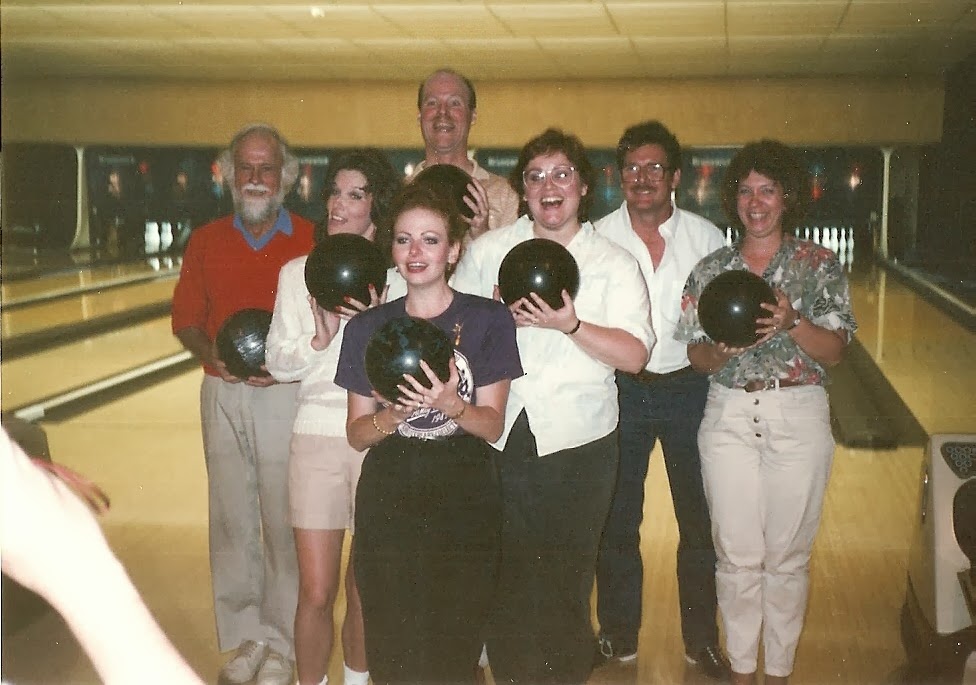
It was an amazing experience. The professional actors were all very down-to-earth and treated us amateurs as equals. (One, I recall, was the daughter of famed travel guide author, Arthur Frommer. I looked up Pauline Frommer while writing this and discovered that some time ago she gave up acting to go into the family business, and is now a well-known travel writer herself.) The pros from New York seemed to enjoy hanging out with us locals—whether it was a picnic in the park before a matinee, or a bowling alley in Niagara Falls after an evening performance. (Bowling, it seemed, was a time-honored tradition for actors who performed at Artpark regularly.)
1989 TSoM Bowling Team
Unfortunately, I don't remember much about the show itself. I do recall several of us listening on the speaker in the green room as our Mother Superior forgot the words to "My Favorite Things" and repeated the same stanza over and over. I also remember that, as a party guest, I had to learn to waltz, and that the song we waltzed to was—you guessed it—"My Favorite Things."
And now that I think about it, I suppose it's not that bad a song. It may not be one of Rodgers and Hammerstein's best, but it's certainly better than "Do-Re-Mi."
Raindrops on roses and whiskers on kittens
Bright copper kettles plus warm woolen mittens
Brown paper packages tied up with strings
These are my favorite things
Cream colored ponies and crisp apple strudels
Doorbells and sleigh bells and schnitzel with noodles
Wild geese that fly with the moon on their wings
These are my favorite things
Girls in white dresses with blue satin sashes
Snowflakes that stay on my nose and eyelashes
Silver white winters that melt into springs
These are my favorite things
When the dog bites, when the bee stings
When I'm feeling sad
I simply remember all of my favorite things
And then I don't feel so bad
Now that Thanksgiving is over, it's time to break out the Christmas music—and I don't mean the latest albums by Susan Boyle and Kelly Clarkson. When it comes to Christmas music, I prefer the classics. Here's what's on my playlist...
First, there are the two quintessential Christmas classics that have been played on the radio every year since before I was born (and are still just as popular as ever): Bing Crosby's White Christmas and Nat King Cole's The Christmas Song. Both are available as downloads and on countless CD compilations—and will never go out of style or print.
During the early years, my parents had only two Christmas records, both ancient, scratchy 78's: Leroy Anderson's Sleigh Ride and A Christmas Festival, performed by Arthur Fiedler and the Boston Pops. One of my earliest Christmas memories is of my mother playing these old records on the portable phonograph my parents had before they bought their first stereo. Both pieces are available—in stereo, non-scratchy versions—as downloads and on CD.
For some reason, when I was a kid, all of the tire companies—Goodyear, Firestone, BF Goodrich—came out with Christmas albums every year. They were all good, but Goodyear's The Great Songs of Christmas—Album Three, from 1962, is my favorite. All of the classic tire company Christmas albums are out of print, but you can find most of the tracks on other CDs or as downloads. My favorites from this album include Eugene Ormandy and the Philadelphia Orchestra, Percy Faith, and the Christy Minstrels—but Carol of the Bells, by Leonard Bernstein and the New York Philharmonic, tops the list.
Here's another great tire album: BF Goodrich's Something Festive, from 1969. This one's all A&M artists: Herb Alpert, Burt Bacharach, Sergio Mendes, The Baja Marimba Band. My mother's favorite was Pete Jolly's jazz piano version of It's the Most Wonderful Time of the Year. My brother, sister, and I listened to Liza Minnelli's schmaltzy Raggedy Ann & Raggedy Andy over and over again. It's laugh-out-loud funny—especially when played at a faster speed. I'm sure most of the tracks are available as downloads or on other CDs—I know the Herb Alpert tracks are. I found a pristine copy of the LP at a swap meet years ago and digitized it. The Pete Jolly track reminds me of my mother, and the Liza Minnelli track makes me think of my brother and sister—and still makes me laugh at any speed.
My all-time favorite Christmas album is A Christmas Sound Spectacular, from 1959. This collection of sacred and secular Christmas music, played on carillon backed by orchestra and chorus, is truly spectacular. A few years ago I found the CD on the Internet and was disappointed to find that it was not nearly as "spectacular" as I remembered it: the CD had been made from a monaural master. But this year, I found it on iTunes in stereo! Considering the album was originally part of RCA's "Living Stereo" catalog, you really need to hear it in glorious stereophonic sound.
I have many other songs on my Christmas playlist (even a few from this century), but these are my favorites. They bring back happy memories of Christmases past, when I was a child and the house was always filled with music, laughter, and love.
And so I'm offering this simple phrase,
To kids from one to ninety-two;
Although it's been said many times, many ways,
Merry Christmas to you!
Yesterday my sister sent me this picture, taken over fifty years ago, of my mother playing me a record* on my parents' brand new stereophonic hi-fi phonograph.**
I had two LPs at the time: Disney's Alice in Wonderland and Let's All Sing with the Chipmunks. However, I suspect that the LP my mother is about to play is the stereo demonstration record that came with the phonograph: Sounds in Space.
I loved this record. I asked my parents to play it for me again and again until I'm sure they were sick to death of it. I loved the way the sound effects filled the room, and the sound of the narrator's voice and footsteps moving from one speaker to the other. But most of all, I loved the music—especially Prokofiev's Lieutenant Kijé and Lena Horne's spectacular live recording of Day In, Day Out, both of which I still love and now have on my iPod.
In this age of instant digital music, iPods, and ear buds, it's hard to imagine the excitement of a four-year-old boy hearing this album for the first time, having previously only heard recorded music from the tinny speaker of a portable record player or transistor radio. Here's a link to the first track on the record. Listen to it, and try to imagine that you are a four-year-old child hearing recorded stereophonic sound for the first time.
(By the way, that distinctive, resonant voice explaining stereophonic sound is Ken Nordine, who was pretty famous in the day for his recordings of beat poetry over jazz background music. He also served as Linda Blair's vocal coach for The Exorcist.)
Footnotes
*Years and years ago, in the last century—before the Internet or iPods—music used to come on vinyl discs, also called "records." A small disc, called a "45" because it played at 45 revolutions per minute, held a single song on each side. Larger discs, called "LPs" for "long-playing," played at 33 1/3 revolutions per minute and held an entire album. There were also "EPs," which were...oh, never mind. Look it up on Wikipedia, if you're really interested.
**A "phonograph" was a device for playing records. "Hi-fi" meant superior, or "high fidelity" sound, and "stereophonic"...never mind. You can look that up, too.