Saturday, January 18, 2014

Ghosts I've Never Met


I'm not sure when I first became interested in the spirit world. I know I was very young. I had not yet learned to read when my grandparents began collecting the Golden Book Encyclopedia for me, one volume at a time, from the local supermarket. When they presented me with Volume 7 (Ghosts to Houseplants), I immediately asked my grandfather to read me the article on ghosts. I was fascinated by the accompanying illustration of Marley's ghost, from Charles Dickens' A Christmas Carol.

Marley's Ghost (original illustration by John Leech)

Although the Golden Book Encyclopedia and my grandfather both assured me that there were no such things as ghosts, I preferred to believe otherwise.

I was obsessed with the Haunted Mansion decades before I finally got the opportunity to ride in a Doom Buggy. My favorite children's record was Disney's Chilling, Thrilling Sounds of the Haunted House. It featured realistic sound effects accompanying such lighthearted "let's pretend" scenarios as "The Unsafe Bridge," "Chinese Water Torture," and "The Very Long Fuse." My favorite, of course, was "The Haunted House," which began:
You are a bold and courageous person, afraid of nothing. High on a hilltop near your home, there stands a dilapidated old mansion. Some say the place is haunted, but you don't believe in such myths. One night, a light appears in the topmost window in a tower of the old house. You decide to investigate, and you never return...

I was a bold and courageous person, and I longed to prove it by meeting a ghost face-to-face.

I must have been eleven or twelve when I discovered the books of professional ghost hunter, Hans Holzer. (My favorite story, chronicled in Ghosts I've Met, concerned decapitated railroad conductor Joe Baldwin, who is said to wander along the railroad tracks in Maco, North Carolina, searching for his head.) I wanted to be a professional ghost hunter too, but I had no idea how to go about it. Somehow, I doubted one would show up for Career Day at my school.

I may never have realized my dream of becoming a professional ghost hunter, but in 2004 I did meet one. I met Richard Senate when some friends and I were asked to perform a murder mystery at Ventura's reputedly extremely haunted Olivas Adobe. Richard conducts ghost tours in Ventura and has written numerous books about the ghosts hereabouts. I asked him if he had ever seen any ghosts at the Adobe. He told me he had witnessed several manifestations of the infamous "lady in black."

I spent many fall evenings rehearsing and performing at Olivas Adobe over the course of the next two years, and during that time I never once saw anything ghostly. Neither did I see any manifestations on three separate visits (one at night, two during the day) to San Diego's famous Whaley House, said to be one of the most haunted houses in America. And, as I previously chronicled in this blog, my overnight stay at a reputedly haunted bed and breakfast in Lake Arrowhead also proved to be disappointing.

I have become increasingly skeptical in my old age.

However, I have not given up hope. One of these days, I plan to visit Ireland. I hear there are plenty of ghosts there.

Until then, there's always the Haunted Mansion.

Saturday, January 11, 2014

The King of the Cats


Yesterday morning, shortly after Loretta left for work, I was startled by a surprisingly loud "MROW-YOW!" from Dickens, who had leaped onto the window sill of the dining room window and was clearly agitated by something outside. I am not ordinarily startled by the sounds our cats make (and they make all sorts of sounds), but Dickens is usually fairly quiet, even when agitated. And it didn't help matters that I happened to be reading a horror story in which a cat is agitated by what turns out to be a horde of rats in the walls.

It was still dark, so I turned on the outside light. I was relieved to see not a horde of rats, but the orange cat we have come to call Julius sitting beneath the dining room window.

I wrote about Julius and his sibling, Greyjoy, last year. Greyjoy no longer comes around, and we fear the worst. Outdoor cats do not survive long in Southern California, where it is not unusual to see coyotes, mountain lions, and even the occasional bear. (Once we even had a Bengal tiger prowling near our neighborhood, but that's another story.) Julius, however, is still around, and spends much of his time in our back yard. He used to keep a safe distance from the house, but lately he has been coming right up on the patio to visit with our cats through the window. I imagine that he is telling Dickens and Zorra, who are strictly indoor cats, what is going on in the outside world.

Which reminds me of a story I came across many years ago.

"The King of the Cats" is an old English folk tale. Like all folk tales, there are many versions. Probably the best known is the one recorded by Joseph Jacobs in his 1894 collection, More English Fairy Tales (in the public domain and available as a free download from Project Gutenberg):

The King o' the Cats

One winter's evening the sexton's wife was sitting by the fireside with her big black cat, Old Tom, on the other side, both half asleep and waiting for the master to come home. They waited and they waited, but still he didn't come, till at last he came rushing in, calling out, "Who's Tommy Tildrum?" in such a wild way that both his wife and his cat stared at him to know what was the matter.

"Why, what's the matter?" said his wife, "and why do you want to know who Tommy Tildrum is?"

"Oh, I've had such an adventure. I was digging away at old Mr. Fordyce's grave when I suppose I must have dropped asleep, and only woke up by hearing a cat's Miaou."

"Miaou!" said Old Tom in answer.

"Yes, just like that! So I looked over the edge of the grave, and what do you think I saw?"

"Now, how can I tell?" said the sexton's wife.

"Why, nine black cats all like our friend Tom here, all with a white spot on their chestesses. And what do you think they were carrying? Why, a small coffin covered with a black velvet pall, and on the pall was a small coronet all of gold, and at every third step they took they cried all together, Miaou—"

"Miaou!" said Old Tom again.

"Yes, just like that!" said the Sexton; "and as they came nearer and nearer to me I could see them more distinctly, because their eyes shone out with a sort of green light. Well, they all came towards me, eight of them carrying the coffin, and the biggest cat of all walking in front for all the world like—but look at our Tom, how he's looking at me. You'd think he knew all I was saying."

"Go on, go on," said his wife; "never mind Old Tom."

"Well, as I was a-saying, they came towards me slowly and solemnly, and at every third step crying all together, Miaou!—"

"Miaou!" said Old Tom again.

"Yes, just like that, till they came and stood right opposite Mr. Fordyce's grave, where I was, when they all stood still and looked straight at me. I did feel queer, that I did! But look at Old Tom; he's looking at me just like they did."

"Go on, go on," said his wife; "never mind Old Tom."

"Where was I? Oh, they all stood still looking at me, when the one that wasn't carrying the coffin came forward and, staring straight at me, said to me—yes, I tell 'ee, said to me, with a squeaky voice, 'Tell Tom Tildrum that Tim Toldrum's dead,' and that's why I asked you if you knew who Tom Tildrum was, for how can I tell Tom Tildrum Tim Toldrum's dead if I don't know who Tom Tildrum is?"

"Look at Old Tom, look at Old Tom!" screamed his wife.

And well he might look, for Tom was swelling and Tom was staring, and at last Tom shrieked out, "What—old Tim dead! Then I'm the King o' the Cats!" and rushed up the chimney and was never more seen.

Illustration by John D. Batten

Saturday, January 4, 2014

O Tannenbaum


Dickens and I got up extra early this morning to sit in the dark and admire the Christmas tree. Today is the day we take it down. I hate to see it go, but it's time. It's as dry and prickly as a desert cactus.

It seems like we just put it up. The holidays went by much too quickly, and we never really had a chance to enjoy it. Dickens did, though. Every year he spends hours lying on his back, looking up at the tree. I remember doing that as a child—lying on my back under the tree, breathing in the piney fragrance (at least until my parents got an artificial tree), gazing up at the lights and my distorted reflection in an ornament.

I wish I could do that now, but there just doesn't seem to be time. Also, it's difficult to get down on the floor these days (and even harder to get back up).

Our tree is more than a symbol of the holidays; it's a journal of the years Loretta and I have been together. The oldest ornaments—some of them antiques which had been in the family for decades when we got them—were a gift from my Aunt Vonna and Aunt Sheila. They brought them to our wedding twenty-five years ago, carefully packed in an old hat box from Wolf & Dessauer's department store.

The first decorations we purchased as a couple were a set of rose-colored glass ornaments (still complete, in spite of being frequently mistaken for cat toys) and an elegant Victorian lady who has not aged a day since she topped our first Christmas tree twenty-five years ago.

There are pictures of cats past and present, and souvenirs of the many trips we have taken together: a cloisonné cat from China, a cable car from San Francisco, a tyrannosaurus skeleton from the Field Museum in Chicago. There are gifts from friends and family, including commemorative ornaments from Mount Vernon and Hearst Castle from my parents, and one from my aunts commemorating the Santa display that lit up the side of the Wolf & Dessauer building when I was a child.

Every year these ornaments bring back joyful memories as we unpack them and hang them on the tree. Now, all too soon, it's time to pack them up again.

But we look forward to the coming year, and to making new memories to hang on next year's tree.


Saturday, December 28, 2013

July 1995


It may seem strange to you that I should be writing about July at the end of December. I was prompted to do so by the photos from my father's Flickr account, which popped up when I was setting up my Flickr account on one of my Christmas gifts: a Kindle Fire tablet.

It may also seem strange to you that my father, who passed away well over a year ago, should still have a Flickr account. I know it seems strange to me. (It seems even stranger that Facebook still asks me if I would like to suggest friends for him. I know Dad would enjoy chatting with Abraham Lincoln and Winston Churchill, but they both refuse to respond to my friend requests.)

The pictures were from the end of June and the first week of July, 1995. Loretta and I had only been living in California for a few months when my father flew out to San Jose to celebrate his brother's 75th birthday. We drove up for my uncle's party, and Dad came back with us to spend the first week of July with us in Southern California.

We visited all the usual tourist spots. Here's a picture Loretta took of Dad and me at the Griffith Park Observatory:

Griffith Park

And here's one of the two of us at the beach:

Zuma Beach

We visited Dad's cousins and his aunt—my Great Aunt Louise—in Thousand Oaks. Aunt Louise lived to be over a hundred years old. I wish my father could have lived as long.

Dad and Aunt Louise

We took the ferry to Catalina. Here's a great picture Dad took of Loretta and me at the Blue Parrot in Avalon, where we had lunch:

Lunch at the Blue Parrot

And here's one he took of some fish we saw on the "submarine" tour:

Fish in Catalina

One day when Loretta was at work, I took my father to Universal Studios. He loved the backlot tour and behind-the-scenes stuff. I think my favorite—the Back to the Future ride—may have been a little too thrilling for his taste. But he was a good sport about it—as he nearly always was about nearly everything.

Universal Studios

We never got to "The Happiest Place on Earth." I wish we had. My father, who was as much a child at heart as I am, would have loved it.

And I would love to have a picture of him wearing mouse ears.

Saturday, December 21, 2013

Driving with Douglas Adams


About this time twenty-six years ago, I was making my annual ten-hour drive from Indiana to Virginia to visit my parents for Christmas. After Christmas, I drove north on I-95, through Baltimore and New York City to Connecticut—a terrible drive, especially in winter. But I didn't mind, because I was going to see the woman I loved. We had been seeing each other for a little over a year—that is, as much as two people who lived 750 miles apart could see each other. I was nervous, because on this particular New Year's Eve, I was planning to ask her to marry me.

I won't keep you in suspense. She said "yes."

When it came time to leave, I was not looking forward to the long, lonely drive back to Indiana. I took comfort from the thought that, by the end of the year, Loretta and I would be married, and I would never have to make that long, lonely drive again. I also took comfort from the lovely parting gift Loretta had given me: an audio book to make the miles go by more quickly. The book was Dirk Gently's Holistic Detective Agency, written and read by Douglas Adams. I knew who Douglas Adams was, of course. I was a great fan of his Hitchhiker's Guide to the Galaxy. I had not heard of Dirk Gently, but I was intrigued by the description on the cover: "THE FIRST EVER FULLY REALIZED GHOST-HORROR-DETECTIVE-WHODUNIT-TIME-TRAVEL-ROMANTIC-MUSICAL-COMEDY-EPIC."

Once I was headed west on the interstate, I popped the first tape into the cassette player. (Back in those days, kiddies, there were no iPods or MP3's. Audio books came on cassette tape, and the only audio option a car had besides a radio was a cassette player. If you were lucky, it played both sides of the cassette without your having to turn it over!) A cultured, slightly nasal English voice issued from the car stereo. "High on a rocky promontory sat an Electric Monk on a bored horse," it said.

"An Electric Monk?" Certain that I had heard incorrectly, I was about to back up the tape and play it again, when the phrase was repeated:

The Electric Monk was a labour-saving device, like a dishwasher or a video recorder. Dishwashers washed tedious dishes for you, thus saving you the bother of washing them yourself, video recorders watched tedious television for you, thus saving you the bother of looking at it yourself; Electric Monks believed things for you, thus saving you what was becoming an increasingly onerous task, that of believing all the things the world expected you to believe.

Unfortunately this Electric Monk had developed a fault, and had started to believe all kinds of things, more or less at random. It was even beginning to believe things they'd have difficulty believing in Salt Lake City.

After that, the story got really weird, with an "impossible" magic trick, a ghost, a famous 19th century romantic poet, aliens, and a time machine.

A time machine?

As a long-time Whovian, I recognized recycled plot elements from two Doctor Who stories written by Adams: "City of Death" and the famously lost "Shada," which never aired due to a strike at the BBC. However, those plot elements were imaginatively combined into something completely new and unique. And while the character of Dirk Gently may have borne a superficial resemblance to Tom Baker's Doctor (both had a child-like curiosity and a penchant for hats that were "a remarkable rather than entirely successful piece of personal decoration"), he was clearly the illegitimate literary offspring of Philip Marlowe and Sherlock Holmes.*

Dirk Gently's Holistic Detective Agency never became the hit Hitchhiker's Guide did, but it did inspire a very good sequel (The Long, Dark Tea-Time of the Soul), a radio adaptation, and a television series. It also made several hours of my long, lonely drive much more bearable, and nearly caused me to miss several exits.

I recently purchased the Kindle version, and I look forward to reading it. Of course, it won't be the same as having it read to me by Douglas Adams, and someday—perhaps on my next long (but not lonely) drive with Loretta—I hope to listen to the cassettes again. Of course, I will first need to find a working cassette player.

Or a time machine.


*"Sherlock Holmes observed that once you have eliminated the impossible then whatever remains, however improbable, must be the answer. I, however, do not like to eliminate the impossible."

Saturday, December 14, 2013

Not One of My Favorite Things


Don't worry, Carrie Underwood fans; I am not going to criticize her recent television performance as Maria von Trapp. First of all, plenty of other people have already done that. Secondly, I didn't watch the show, because—I know this will shock some of you—The Sound of Music is not one of my favorite musicals. There, I said it. And guess what? I'm not the only one who feels that way. One critic of the original production complained that it was "not only too sweet for words but almost too sweet for music." A director I once knew always referred to it as "The Sound of Mucus."

As a child, I loved the movie. I already had a crush on Julie Andrews, having seen Mary Poppins the year before. I loved the music, too. I played the soundtrack album again and again until it was so worn out and badly scratched it was almost unplayable. (It always got stuck at the yodeling part of "The Lonely Goatherd," which I found hilarious.)

Maybe that's why it's difficult for me to listen to the music now—especially "My Favorite Things." Unfortunately, it's difficult to avoid that song this time of year, because for some reason it has become associated with Christmas. This is a pet peeve of mine. "My Favorite Things" is not a Christmas song. It's a song about—well, favorite things. So what if those favorite things include "snowflakes" and "sleigh bells" and "packages tied up with strings?" Just because you have snowflakes and sleigh bells, doesn't mean it's Christmas. And if those "packages tied up with strings" were Christmas packages, wouldn't they be wrapped in something besides plain old "brown paper?" But I digress.

Because TSoM is not one of my favorite musicals, I tend to forget that I was once in it.

It was the summer of 1989. Loretta and I had been married less than a year, and I was having difficulty finding work in the Buffalo area. (Not an uncommon problem, which is how we ended up in Southern California.) I answered an ad for a paid acting job at Artpark, a beautiful park and open-air theater located on the scenic Niagara Gorge. All of the major roles in the musical were to be played by professional Broadway actors, but the children and supernumeraries (chorus members without lines) were to be locally cast.

I was given several minor roles—the largest of which was the priest performing the marriage ceremony between Captain von Trapp and Maria. I was also a tuxedoed guest at the party where the children sing "So Long, Farewell," and a runner-up in the Kaltzberg Festival contest, during which the von Trapps make their escape near the end of the play.

1989 Kraltzberg Festival Runners-Up (I'm the one on the left)

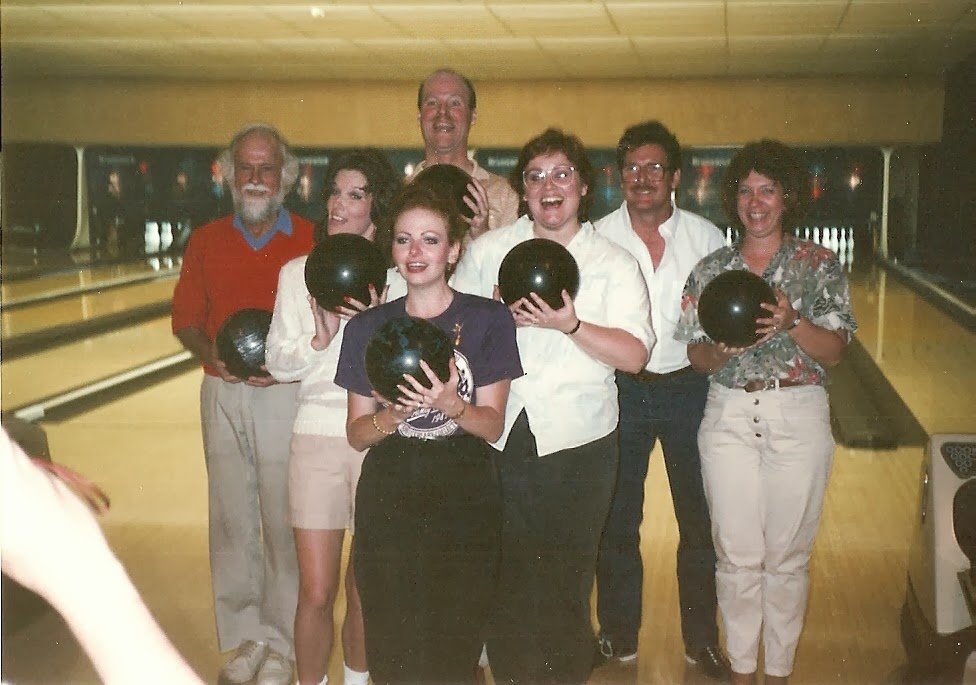
It was an amazing experience. The professional actors were all very down-to-earth and treated us amateurs as equals. (One, I recall, was the daughter of famed travel guide author, Arthur Frommer. I looked up Pauline Frommer while writing this and discovered that some time ago she gave up acting to go into the family business, and is now a well-known travel writer herself.) The pros from New York seemed to enjoy hanging out with us locals—whether it was a picnic in the park before a matinee, or a bowling alley in Niagara Falls after an evening performance. (Bowling, it seemed, was a time-honored tradition for actors who performed at Artpark regularly.)

1989 TSoM Bowling Team

Unfortunately, I don't remember much about the show itself. I do recall several of us listening on the speaker in the green room as our Mother Superior forgot the words to "My Favorite Things" and repeated the same stanza over and over. I also remember that, as a party guest, I had to learn to waltz, and that the song we waltzed to was—you guessed it—"My Favorite Things."

And now that I think about it, I suppose it's not that bad a song. It may not be one of Rodgers and Hammerstein's best, but it's certainly better than "Do-Re-Mi."
Raindrops on roses and whiskers on kittens
Bright copper kettles plus warm woolen mittens
Brown paper packages tied up with strings
These are my favorite things

Cream colored ponies and crisp apple strudels
Doorbells and sleigh bells and schnitzel with noodles
Wild geese that fly with the moon on their wings
These are my favorite things

Girls in white dresses with blue satin sashes
Snowflakes that stay on my nose and eyelashes
Silver white winters that melt into springs
These are my favorite things

When the dog bites, when the bee stings
When I'm feeling sad
I simply remember all of my favorite things
And then I don't feel so bad

Saturday, December 7, 2013

My Christmas Video List


Last week I posted a list of my favorite music of the season. I now present my list of must-see Christmas videos:

The Nightmare Before Christmas. Only the mind of Tim Burton could have produced such a perfect blend of my two favorite holidays. Apologies to Thanksgiving fans who complain that their favorite holiday gets lost in the rush to Christmas, but seriously—can you imagine how dull this movie would have been if Jack Skellington had fallen through the turkey door instead of the one with the Christmas tree? A bunch of monsters eat a big turkey dinner and then fall asleep on the couch while watching football. (Yawn.)


A Charlie Brown Christmas. I grew up with this classic, and I still like to watch it while decorating the tree. Because, let's face it, any tree looks good compared to Charlie Brown's. My favorite moment comes when Schroeder begins pounding out Vince Guaraldi's jazzy score during the Christmas play rehearsal, and the other characters spontaneously break into a dance of pure joy—each grooving to the music in his or her own way. Then Charlie Brown has to go and ruin the moment by screaming at everyone. What a blockhead. I've had directors like that.


Rudolph the Red-Nosed Reindeer. Another childhood favorite, but sometimes I honestly have to wonder why I still watch it every year. It helps to think of this disturbing story of bullying and intolerance as a period piece—a sort of North Pole Mad Men with Santa as Don Draper. Thank goodness we now live in more enlightened times. These days, anyone encouraging an openly hostile work environment such as Santa did in the 1960's would be subject to legal action. And if an elf wants to be a dentist, he can now do so without fear of being condemned by society—in most states, anyway.


How the Grinch Stole Christmas. The original, of course—not the Jim Carrey movie (which I have never seen and probably never will see, because—Jim Carrey). As many times as I've seen it, I still thrill at that harrowing sled ride down Mount Crumpit and get a tear in my eye when the Grinch's heart grows three sizes—thanks to the brilliant animation of Chuck Jones and the heartfelt narration of Boris Karloff. "Welcome Christmas while we stand, heart to heart and hand in hand."


The Snowman. Raymond Briggs' magical tale of joy, love, and loss is told, like the book, without a single word of dialogue. The flying sequence, accompanied by Howard Blake's haunting Walking in the Air sung by boy soprano, might just be the most perfect piece of animation ever created. And if you don't shed a tear or two at the end, well, perhaps you need to be visited by a Christmas ghost or three. Speaking of which...


The Three Scrooges. There have been about as many adaptations of A Christmas Carol as there have been Christmases since it was first published in 1843. I've probably seen at least a dozen of them (though not the recent animated version, because again—Jim Carrey.) In my opinion, the following are the cream of the Christmas Carol crop, and I must watch each and every one of them every year:

Don't laugh. Critics generally agree that Mister Magoo's Christmas Carol is one of the best adaptations. (At least one says the best.) It was my introduction to Charles Dickens, and probably has a good deal to do with the fact that he is still my favorite author. I love the way the story is framed by the opening number ("It's Great to Be Back on Broadway") and curtain call as if it were a stage musical, the "camera" zooming back at each scene break to show the "proscenium" and "audience." Mister Magoo (voiced by Jim Backus, who also played Mr. Howell on Gilligan's Island) makes a fine Scrooge, and Jack Cassidy an equally fine Cratchit. The songs by Broadway composers Jule Styne and Bob Merrill (whose next project was Funny Girl) are unforgettable. My favorite is "All Alone in the World," a touching duet between old Scrooge and his younger self:
A hand for each hand was planned for the world
Why don't my fingers reach?
Millions of grains of sand in the world
Why such a lonely beach?

Leslie Bricusse's songs for the 1970 film Scrooge are also, for the most part, unforgettable. (I would prefer to forget Tiny Tim's sappy "The Beautiful Day"—especially when we hear it in a muffled reprise at his grave, as if the poor child had not only been buried alive, but still singing.) There are fine performances by Albert Finney as Scrooge, Edith Evans as the Ghost of Christmas Past, and Kenneth More as the Ghost of Christmas Present, as well as an eccentric portrayal of Marley's Ghost by Alec Guinness. A stage version exists, and if anyone ever produces it around here, I would kill to play the Ghost of Christmas Present. He has a fantastic song ("I Like Life"), as well as some of the best lines in the show:
Scrooge: (at the home of Bob Cratchit) I want to look in the window.

Ghost of Christmas Present: It will cost you nothing, which I'm sure is good news for you.

Scrooge: Will they be able to see me?

Ghost of Christmas Present: No, which I'm sure is good news for them.

In my opinion, the epitome of all Christmas Carols, the one by which all others should be judged, is the 1951 Alistair Sim version. Gorgeous, atmospheric black and white cinematography (beware of colorized versions!), a haunting score, and superb performances by a bevy of brilliant British character actors led by Sim. Oh, he's marvelous as the "squeezing, wrenching, grasping, scraping, clutching, covetous, old sinner" at the beginning of the story, but it's his performance as the transformed Scrooge at the end that makes this version so delightful. His irrepressible laughter is infectious; you can't help but laugh along with him.


A Child's Christmas in Wales. I particularly enjoy watching this on Christmas Eve in front of a cozy fire, although there is so much warmth in the story that the fire is optional. It reminds me of the Christmases of my childhood (which is strange, because I did not grow up in 19th century Wales) and, like a cup of hot cocoa on a cold wintry day, makes me feel all warm and happy inside. By the end, as Denholm Elliott puts his grandson to bed with the following words, I'm usually dozing off, too:


Looking through my bedroom window, out into the moonlight and the unending smoke-colored snow, I could see the lights in the windows of all the other houses on our hill and hear the music rising from them up the long, steady falling night. I turned the gas down, I got into bed. I said some words to the close and holy darkness, and then I slept.

I have other holiday favorites—It's a Wonderful Life, A Christmas Story, The Polar Express, Elf, Bad Santa (hey, a healthy dose of cynicism is good from time to time; besides, the ending is sweet in its way), and more—but I don't need to see them once a year. Those in the above list must be viewed no later than Christmas day, every year, without exception.

Now if you'll excuse me, I have videos to watch.