Saturday, October 12, 2013

Kotor and Ravenna


The next port of call on our APHC cruise was Kotor, Montenegro. Here is a picture Loretta took from the deck of the ship:

Kotor, Montenegro


It's a lovely scene, isn't it? That's all I ever saw of Kotor. It's what I could see from the window of our cabin, which is where I spent the entire time we were in port.

In my last post, I wrote that when we left Naples, I felt like I was coming down with a cold. The first symptoms weren't so bad: just a cough and sniffles. However, approximately twenty-four hours after we witnessed the eruption of Mount Stromboli, I was awakened in the middle of the night by rumblings in my bowels signaling an impending eruption of my own.

I will spare you the grisly details. Suffice it to say, I had a rough night. When morning came I felt much better, but I had taken the last of the Imodium. The ship's sundry shop would be closed until after we left port, so I made my way down to the ship's medical center to see if they could provide me with some, just in case.

The doctor on duty said she had "good news" and "bad news." The good news was that she had Imodium, which she gave me (or rather, sold me)—along with Tylenol and Dramamine (neither of which I needed) and several disposable thermometers (although I did not have a fever). The bad news was that I would have to be isolated for twenty-four hours from the time of my last "eruption." I was not allowed to leave our cabin, and no one was allowed to visit (not that anyone would want to)—except for Loretta, who was free to come and go unless she got sick. Not even our steward was allowed to enter the cabin. Instead, a "sanitation team" would do the cleaning.

As I returned to the cabin, I thought of Mark Twain and his friends who, in The Innocents Abroad, sneaked ashore when their ship was quarantined at Athens. These days, with magnetic ID cards that track everyone who boards or leaves the ship, such a thing would be impossible.

At least we didn't have an excursion planned. Susan and Kevin took a tender ashore to do some exploring. I told Loretta she should go with them, but she insisted on staying on board with me. We began filling out the six-page survey the doctor had given me, listing everything I had put in my mouth for the past three days. (You should try it sometime. It's a real test of your memory to recall everything you have had to eat and drink in the past 72 hours.)

When the sanitation team arrived, Loretta had to leave. There wasn't enough room. I felt like Groucho Marx in the stateroom scene in A Night at the Opera, as men in masks and plastic gloves piled in, stripped the bed, bagged all towels and linens, and sprayed and wiped down all surfaces with disinfectant. Oddly enough, they did not remove the towel origami pig our steward had made us the night before. They left it on Loretta's bedside table. They did, however, spray it with disinfectant.

I discovered that being sick on a ship isn't all that bad. The ship's crew pampered me almost as much as my mother did when I was sick as a kid. Room service brought me a tray with broth, crackers, and ginger ale. The front desk called and offered to send down books and DVDs. I told them "no thanks." I had Mark Twain on my Kindle, along with several dozen other books, but I spent most of my time watching the ship's satellite TV—mostly made-for-TV movies I would never have watched at home. I slept a lot, too—often dozing off during one movie and waking up during the next. I was confused when King Arthur and Sir Lancelot in The Mists of Avalon suddenly turned into Steve Jobs and Bill Gates in Pirates of Silicon Valley, and when Bill Pullman as The Virginian metamorphosed into Mandy Patinkin as The Hunchback of Notre Dame.

Loretta came and went. She saw some of the shipboard entertainment and went on deck to take pictures so I could see more of Montenegro than could be seen from our window. The sanitation crew came and went, stripping the bed again (though I had not slept in it), wiping everything down again, and giving the pig another spritz of disinfectant.

I slept well that night and awoke feeling fine. It was our last day on board the MS Ryndam, and I intended to make the most of it. I paced the cabin, waiting for permission from the medical center to leave "the brig." Finally, the call came at 7:45: I was free!

Over breakfast (just oatmeal and bananas for me), Susan and Kevin told us about Kotor, and Susan showed us her pictures. It's a quaint, pretty city, known for its large population of cats. We were sorry to have missed the cats. We talked about how much we all missed our own: Molly and Murphy, Dickens and Zorra.

Kotor Cats Dining on Sardines (photo by Susan Logue Koster)


After breakfast, there was a meet and greet on the Lido Deck with Garrison Keillor. Susan and I stood in line: Susan with a copy of his latest book, I with the souvenir t-shirt Loretta had already gotten most of the other entertainers to sign. When my turn came, I told him what a wonderful time we were having (not mentioning the twenty-four hours I spent in quarantine), and how much we enjoyed the Alaska cruise seven years ago. I asked him how he thought this cruise compared with Alaska. "This one's good," he replied. "Anywhere you can be on a boat with people singing." I handed him my t-shirt and told him my name; he signed it and handed it back. I looked at what he had written:

Hi Don! It's you.
Garrison Keillor

While we were having lunch, the ship arrived in Ravenna. We took a bus into the center of the city and explored it on foot, without guide or guidebook, map or GPS. I don't know if it was because I felt so much better after being sick for twenty-four hours, or because it felt so good to be outside after being cooped up in the cabin, but I loved Ravenna. The city was charming, the weather was perfect, the crowds—well, that was the best part. There were no crowds. We strolled through peaceful, quiet streets, alleys, and piazzas—past Dante's Tomb, Teatro Alighieri, the house where Byron once lived, and another leaning tower (apparently there are leaning towers all over Italy). When we were tired of walking, we found a quiet cafe in the sun-drenched Piazza del Popolo, where we sat in the shade and drank prosecco.
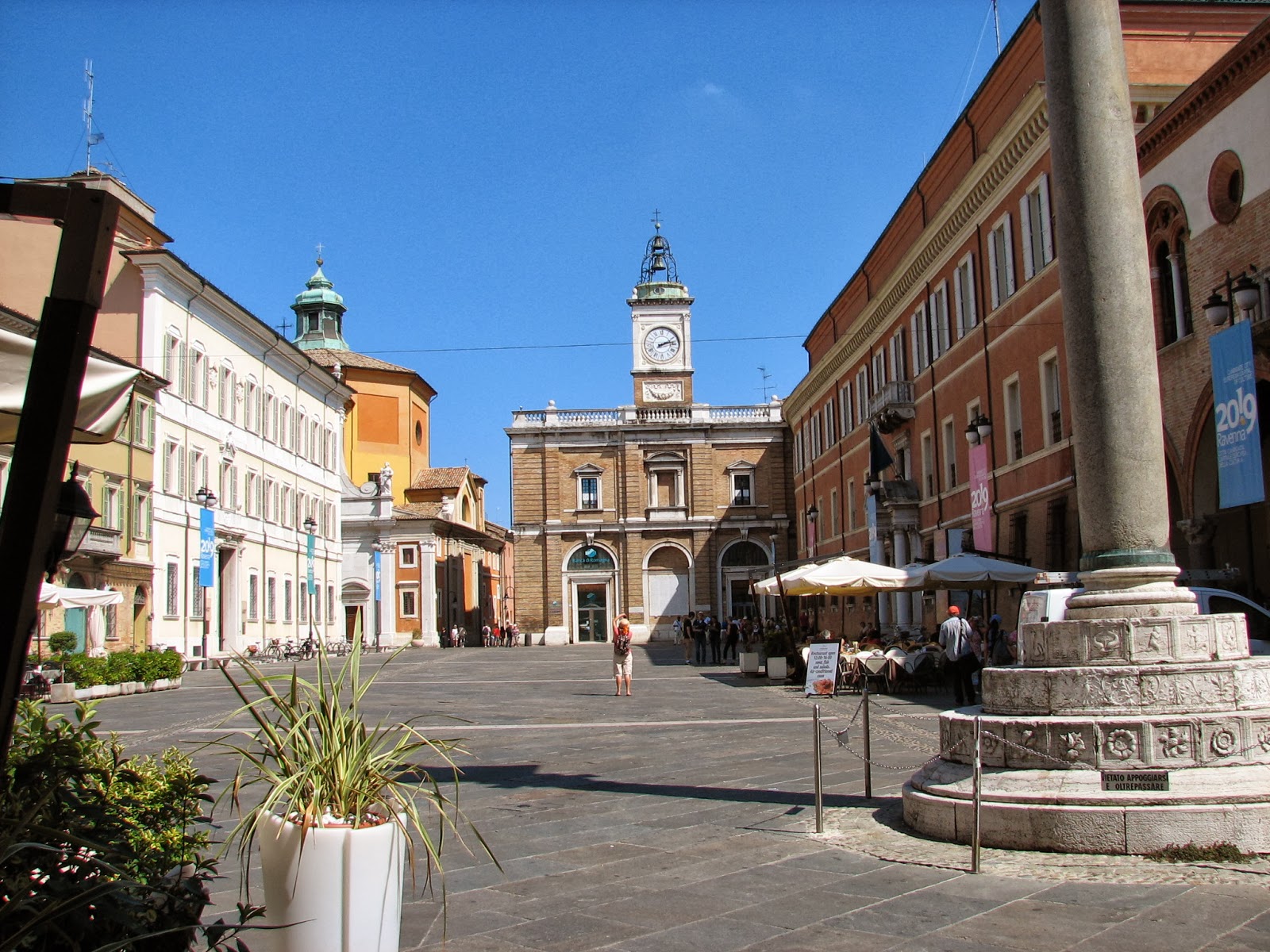
Piazza del Popolo, Ravenna, Italy


Before we left town, we went into a grocery near the bus stop and bought several boxes of cookies to bring back to co-workers. We thought they were Italian cookies, but it turned out they were imported from Germany.

Someday, we hope to visit Germany and buy some Italian cookies there.


Courtyard in Ravenna


Adieu! Adieu! yon silver lamp, the moon,
Which turns our midnight into perfect noon,
Doth surely light thy towers, guarding well
Where Dante sleeps,
where Byron loved to dwell.


—Oscar Wilde, Ravenna

Saturday, October 5, 2013

The Ruins of Pompeii


In Napoli, where love is king,
When boy meets girl here's what they say—
When the moon hits your eye like a big pizza pie
That's amore!
We had hoped to sample a big pizza pie in Naples, the fifth port of call on our Mediterranean cruise, but there just wasn't time. We had to see The Ruins of Pompeii. Here's the description from the brochure:
From the pier, it’s a 45-minute ride by motor coach to the remarkable ruins of Pompeii, perfectly preserved since the eruption of Mt Vesuvius in AD 79. On a guided walking tour you will learn about the excavation techniques that have uncovered this city remarkably intact and what the residents were doing at the time of the eruption. You'll gain an insight into the lives of the ancient Romans as you discover baths, theatres, temples, markets and the huge forum.
Not surprisingly, a lot of people on the ship wanted to see Pompeii, and multiple buses were required. Susan and Kevin were assigned to a different tour than ours. Our guide's name was Massimo. As we set out, he pointed out Mount Vesuvius and explained that it was dormant, but not extinct. He said that it probably would not erupt today, but if by chance it did, we were welcome to join him in running a brisk half-marathon back to the ship.

Mark Twain visited Pompeii in 1867. (You can read his account here.) Little has changed since he was there—including what he refers to as "the only building in Pompeii which no woman is now allowed to enter." Women are allowed to enter it today, of course, and it is one of the most popular attractions in Pompeii. Susan and Kevin's group saw it. Our group didn't, but Massimo told us about it: the sailors who frequented it, the "friendly girls" who worked there, and the naughty illustrations that still adorn its walls.

What we did see was what was left of the baths, a typical house, the temple of Apollo, and several bakeries and restaurants. Massimo kept us moving. Whenever another tour was about to overtake us, he would exclaim, "Andiamo! We are being invaded again!" and off we'd go.

Massimo

And then we came to the bodies.

At the show that evening, Garrison jokingly boasted that he did not go to Pompeii. He accused those of us who did (including his wife) of having a ghoulish interest in dead bodies. I suppose there may be something to that. When our group came to the glass cases holding the bodies (actually plaster casts of bodies, but here and there you could see a bone peeking through), we were all drawn to them like moths to a flame. What was fascinating, horrifying, and heartbreaking about them was that, from their poses, you could see the surprise and terror in which they died.

Victims of Vesuvius

But to me the most interesting thing about Pompeii is not seeing how the people died; it's seeing how they lived: their houses, temples, businesses, streets, and elaborate plumbing and drainage system. Their engineering was remarkably sophisticated. Unfortunately, Massimo told us, their lives were shortened by the toxic lead they used for just about everything; it can be found in the paint, the mortar between the stones, and, most unfortunately, the plumbing. This was probably their second biggest mistake. (Their biggest mistake, of course, was building their city beneath a volcano.)

Vesuvius and the Ruins of Pompeii

That night, the captain announced that we would be passing by an active volcano—Stromboli—and if we got up early, we might see an eruption. We set our alarms, and at five a.m. we stumbled out of bed, threw on some clothes, and made our way up to the bow of the ship. Ahead of us we could barely see the outline of a mountain against the dark sky, with a dim orange glow at its peak. We all stared at it for several minutes. I believe everyone was thinking of Mount Vesuvius and its victims. I know I was.

That morning we squeezed past Sicily through the Strait of Messina, rounded the toe of Italy's boot, and headed north toward the Adriatic Sea. This was our "at sea" day, and I planned to spend most of it sipping mimosas (for the vitamin C) and napping. I had returned from Pompeii with a hacking cough, and now I had developed a runny nose. Clearly, I had picked up a virus, but it was only a cough and sniffles. It could be a lot worse, right?

As it turned out, it was.

Saturday, September 28, 2013

Rome Overnight Experience


The fourth port of call on our Mediterranean cruise was Civitavecchia—"Gateway to Rome." Once again, we had many excursions to choose from. The four of us who were traveling together—my sister Susan, brother-in-law Kevin, Loretta, and I—chose the "Rome Overnight Experience," which included a tour of the Colosseum, a walking tour of Rome, and a tour of the Vatican. Our guide's name was Alessia. On the bus, she handed out beautiful, detailed maps of the city, which we put away and never looked at again. She explained that ancient Rome was on the left bank of the Tiber River (which was on the right side of our map), while Vatican City was on the right bank (the left side of our map).

Once we were in the city, we stopped to pick up another guide: Alessandra. Apparently, Alessia was not licensed to guide us within Rome, and there are strict laws about such things. (I found this account of an unlicensed guide who was arrested in the middle of a tour, leaving her group stranded at the Forum.) Like our guide in Pisa, Alessandra warned us about pickpockets. However she told us not to worry too much, because "the worst pickpockets are in the government." We were equipped with state-of-the-art radio receivers which ensured that we could always hear Alessandra's voice. They did not, however, give us any indication which direction her voice was coming from; we soon learned that if we did not keep up, we could easily get lost from the group.

Our first stop was the Colosseum. By the way, did you know that "Colosseum" was not the actual name of the building? The actual name was "Flavian Amphiteatre." It became known as "The Colosseum" because of the large statue ("colossus") that once stood outside it. Of it, Mark Twain wrote:
More vividly than all the written histories, the Coliseum tells the story of Rome's grandeur and Rome's decay. It is the worthiest type of both that exists. Moving about the Rome of to-day, we might find it hard to believe in her old magnificence and her millions of population; but with this stubborn evidence before us that she was obliged to have a theatre with sitting room for eighty thousand persons and standing room for twenty thousand more, to accommodate such of her citizens as required amusement, we find belief less difficult.
What sort of amusement did those citizens require? According to Alessandra, the lunchtime executions were popular, as were the wild animal hunts. At times, if some accounts are to believed, the amphitheater was even flooded to portray naval battles. However, the most popular events were the gladiator matches. The best gladiators were like the rock stars of today, and if they were very good (and very very lucky), they might live long enough to win their freedom and retire to live lifestyles of the rich and famous.

Alessandra shows us where the Roman sports fans sat.


We boarded the bus again and drove by other landmarks: the Circus Maximus, the Forum, Caesar's Palace (the real one), and the Victor Emmanuel Monument. We then got off the bus for a walking tour that took us past the Spanish Steps, Trevi Fountain, and the Pantheon, and ended at the Fountain of the Four Rivers in Piazza Navona.

We were told we had an hour of free time, and to meet back at the fountain. We retraced our steps for a closer look at the Pantheon, then returned to a sidewalk cafe next to our rendezvous place. Our timing was perfect. We had felt a few sprinkles on our walk; as soon as we were served our drinks, it began to pour. I think my favorite memory of Rome is of the four of us sitting in that cafe, sipping espresso and watching people in the piazza run for cover.

After the brief downpour, the city felt cooler, fresher, and cleaner. We met up with our tour group and walked to a nearby restaurant for lunch, after which the bus took us to our hotel. Once we were checked in, we had a nice nap. We had been told that it was common in Italy to take a siesta—or "riposo"—in the afternoon, and as they say, "When in Rome..."

In the evening we gathered in the lobby and were herded, along with several other tour groups staying at the hotel, onto buses to take us to dinner at Tanagra Caffe Concerto—a sort of operatic dinner theater. Between courses, we were entertained by a pianist and singers performing a selection of popular arias, duets, and quartets. There was some audience participation, and I had the honor (no doubt due to my lack of hair) of being chosen as a customer by Figaro, the famous "Barber of Seville." Thanks to my stellar performance, I became a minor celebrity on board the ship and learned not to be insulted when strangers asked me if I needed a shave.

A Close Shave (photo courtesy of David Lawrence)


After dinner, we were to have a night-time bus tour of the city before being returned to our hotel. We four were among the last to board. We got on a bus that supposedly had four empty seats, only to find that a woman was saving an empty seat for her husband. Loretta and I got off and found seats in the last row of another bus. There was a delay getting started; the guides had to check each bus to see if the lady's missing husband was on one of the other buses. I'm not sure they ever found him. He may still be in Rome.

Rome is beautiful at night—I suppose. I can't say I enjoyed it much. The woman sitting across from me wasn't enjoying it, and she was determined to make sure nobody else on the bus—at least nobody within earshot—was going to enjoy it either. A few minutes into the tour, she began to fidget and sigh, then to yawn loudly. Finally, she began not-so-quietly whining, to herself or to anyone who would listen (and believe me, we all tried our best not to): "This is pointless! ... Didn't we see this this morning? ... Does anyone really want to be doing this?"

Clearly someone did not get her afternoon riposo.

(I was reminded of the stories my Aunt Vonna used to tell about her great-aunt—my Grandfather Shorter's Aunt Flo. By all accounts, Aunt Flo seldom had anything positive to say about anything. When she returned from a trip to Europe, my grandmother asked her how she enjoyed it. "Oh, June," she replied, "It was nothing but ruins. Nothing but ruins!")

After breakfast the next morning, we checked out of the hotel and boarded our bus for the Vatican tour. (By the way, if you plan to visit the Vatican, I recommend you only do so with a guided tour. People were lined up around the block to get in, but we zipped past them in our own special line and went straight to the front.) Our guide this time was Sylvia. Once we were inside the Vatican Museum, she told us that it would take decades to see everything, even if you only stopped for couple of minutes at each exhibit. I don't see how it would be possible to stop for a couple of minutes at each exhibit. The museum was so crowded, it was like being swept along by the current in a river of people. I vaguely recall seeing some statues and tapestries. It was impossible to get good pictures.

It's impossible to get any pictures in the Sistine Chapel, because it's not allowed. Basically, nothing is allowed in the Sistine Chapel—not even talking. Sylvia had to tell us what we were going to see before we went in. The ceiling was impressive, of course, but what I found most fascinating was Michelangelo's face on the flayed skin of a saint. Sylvia had told us that this self-portrait in The Last Judgment was a rarity. Unlike other Renaissance artists, Michelangelo almost never painted himself into his works. If he was truly that ugly, I can see why. If he hadn't been such a great artist, he could have gotten a job posing as a model for gargoyles.

Sylvia tells us what a brilliant, unattractive man Michelangelo was.


What can I say about St. Peter's Basilica? Well, for one thing, it's big. When it comes to architectural beauty, I'll take Notre Dame de Paris or Barcelona's Sagrada Familia, but you certainly can't beat St. Peter's for size. And it has something else those other churches don't: popes—loads of them, from St. Peter himself to John Paul II. They thought so much of this pope that they covered him in silver and put him on display like the crown jewels:

Silver-Plated Pope


I believe there were even a couple of live popes somewhere in the vicinity, but we didn't see them.

We had lunch at Papa Rex, a restaurant just outside the Vatican. Then it was "Arrivederci Roma," as we boarded the bus to return to the ship. We were all pretty much exhausted by our visit to Rome. You're probably exhausted reading about it. I know I'm tired of writing about it.

Time for a riposo.

Saturday, September 21, 2013

Monte Carlo, Bird Watching, and Pisa


I made a grave tactical error when packing for our APHC Mediterranean cruise. I did not pack enough light clothing, and we encountered nothing but hot, humid weather everywhere we went. I packed a pair of jeans and a pair of black dress slacks (neither of which I ever wore), a pair of shorts, a pair of white pants, and a brand new pair of khakis which turned out to be mislabeled and were four sizes too small. The first day of the cruise I got a nosebleed, which of course dripped onto my white pants.

Not to worry. There was a laundromat on board the ship.

I wore my shorts in Monte Carlo, and I felt like a slob. In Monte Carlo, you expect everyone to go around looking like Cary Grant or Grace Kelly, and a lot of them do. If they wear shorts and tee shirts, they wear designer shorts and designer tee shirts—with thousand-dollar Italian sandals. In the fashionable, art-nouveau-style cafe where we had lunch, I felt especially self-conscious and out-of-place.

Then a man came in. Until the maitre d' seated him, I figured he worked there—probably as a dishwasher. Think of Marlon Brando as Stanley Kowalski in A Streetcar Named Desire. Got the picture? Okay, now forget Brando and picture Danny DeVito in the same role.

After that, I felt a little less self-conscious.

On the circle outside the Casino and the Hotel de Paris were parked only Rolls Royces, Bentleys, and pricey Italian sports cars. We tried to go into the Hotel de Paris lobby, but the doorman wouldn't let us. (How did he know we weren't guests?) We didn't try to go into the Casino.

Monte Carlo Casino


I think everyone from our ship felt a little uncomfortable in Monte Carlo. Most of us were Midwesterners and not used to such extravagance. (Although I suppose it could be argued that being on such a cruise was fairly extravagant itself.) As Garrison Keillor sang at the APHC performance that evening:
Here you are, an American, sweaty, in T-shirt and jeans,
Monolingual, innocent, whatever that means,
Pale, and you have no yacht with whistles and bells,
But as your mother said, You're as good as anyone else,
So don't stand there, averting your gaze, twisting your right shoe.
You have a right to be here too.
Your manners are nice and you speak English rather prettily.
So let's go to Italy.
And so we did.

Our first port in Italy was Livorno—which for some reason in English is called "Leghorn" (and yes, it's where the chickens come from). We had several options for excursions, including Florence, Pisa, and Tuscany. We chose the "Lake Massaciuccoli Bird Watching & Pisa" excursion (primarily because it included a visit to a winery). While it's not a bad idea to wear shorts when bird watching, you cannot wear them in a cathedral. Therefore I wore my clean white pants, in case we should decide to enter the cathedral in Pisa.

Our guide was an Australian transplant named Jon. He and our bus driver, Giovanni, took us to Lake Massaciuccoli, where we met up with our bird-watching guide, a local named Gabriele. Gabriele was very knowledgeable about birds, although he only knew them by their Italian names, which led to some confusion among the serious birders on our tour. We had some very serious birders on our tour. I am not a serious birder, but I enjoyed the boat ride on Lake Massaciuccoli, which, aside from being a wildlife preserve, is also famous for being the location of Puccini's summer home. We saw a lot of birds, but I only got a picture of one. I think it's a cormorant, although it may be a penguin. It's difficult to tell from this picture.

Lake Massaciuccoli Cormorant (or Penguin)


I enjoyed the boat ride far more than I enjoyed our hike through the wetlands afterwards. It was hot and humid, and there was no shade. At least for most of the hike we were on a board walk. However, at one point, Gabriele picked three "volunteers," including myself, to get off the board walk and jump up and down on the ground, in order to demonstrate that the "islands" we were walking on were actually floating masses of sphagnum moss. Three large people (Gabriele clearly chose his volunteers for their size) jumping up and down in unison had the desired effect of causing the island we were standing on to bob up and down like a raft. It also had the undesired effect of splashing mud onto my pants.

My clean white pants.

Before visiting Pisa, we stopped for lunch at Tenuta Gaetano Spadaro, an organic farm which produces wine and olive oil, nestled in the beautiful hills of Tuscany. It being a winery, there was, of course, wine: red to go with the pasta, white to go with the pork ("the other white meat"), and sweet "vin santo," or "holy wine," in which to dunk our biscotti.

Tenuta Gaetano Spadaro


It was Saturday afternoon, and Pisa's Piazza del Duomo was hot and crowded. According to Jon, the baptistry, cathedral, and bell tower all lean—each in a different direction. You may be able to see that in the following picture, or maybe not. I discovered that it is difficult to take a picture of any of these structures while keeping the camera level; one has a tendency to tilt to compensate.

Baptistry, Cathedral, and Bell Tower of Pisa


We did not enter the cathedral, so I needn't have worn my long pants after all. We also did not climb to the top of the tower. We did not have time. Even if we had had time, I don't believe I could have done it—especially after reading Twain's account in The Innocents Abroad: "Standing on the summit, one does not feel altogether comfortable when he looks down from the high side; but to crawl on your breast to the verge on the lower side and try to stretch your neck out far enough to see the base of the tower, makes your flesh creep, and convinces you for a single moment in spite of all your philosophy, that the building is falling. You handle yourself very carefully, all the time, under the silly impression that if it is not falling, your trifling weight will start it unless you are particular not to 'bear down' on it."

The best thing about Pisa is that none of us had our pockets picked there. From what Jon told us, we were lucky. Near the cathedral, we saw a handbag that had been picked clean and discarded, and, as we were leaving, Jon pointed out a gang of young women who were working the crowd near the bus stop.

Everywhere on our trip, we saw traces of the Roman Empire. On the drive back to the ship, our route took us on what was once an old Roman road. It was lined with beautiful umbrella pines—the same type of trees (though not the same trees) planted by the Romans to shade the road from the hot sun. We also saw sections of an aqueduct. I was reminded of a line from Monty Python's Life of Brian: "All right, but apart from the sanitation, medicine, education, wine, public order, irrigation, roads, the fresh water system and public health, what have the Romans ever done for us?"

Of course the best place to see evidence of the Romans is in Rome, which was to be our next stop.

But first I needed to wash my pants again.

Saturday, September 14, 2013

Marseille(s)


Is there anything more relaxing than an ocean voyage? Practically the only source of anxiety on our APHC Mediterranean cruise was deciding which shipboard entertainers to see: Heather Masse by the pool on the Lido Deck, Butch Thompson at Mix piano bar, the DiGiallonardo Sisters in the Ocean Bar, or Robin and Linda Williams in the Crow's Nest.

Well, there was one other source of anxiety: the toilet in our cabin. Sometimes it flushed when it was supposed to flush; most of the time it flushed five or ten minutes after pressing the button. The evening of our second day at sea, it didn't flush at all. The engineer (which, we discovered, is what they call the plumber on a ship) finally got it to flush, but there was still no telling when it would happen.

Our first stop was Marseille—or "Marseilles," if you prefer the English spelling, as Mark Twain did. He wrote, "In Marseilles they make half the toilet soap we consume in America, but the Marseillaise only have a vague theoretical idea of its use, which they have obtained from books of travel." I suspect this is no longer true, but I can't say for sure, as we never saw Marseille(s). Instead we chose to take a bus excursion to Avignon and Châteauneuf-du-Pape, a region known for its wine.

We chose many of our excursions based on whether or not they included wine.

Our tour guide was Olivier; our bus driver was Martine. Olivier informed us that Avignon was not far—"only an hour ago from here." It is a city with an ancient history, dating back to before the Roman Empire. There is a famous song about its bridge:
Sur le Pont d’Avignon
L'on y danse, l'on y danse
Sur le Pont d’Avignon
L'on y danse tous en rond
Technically, it's no longer a bridge. You could say it's half a bridge, or maybe a pier. In any case, if you try to cross it, you will end up in the Rhône River. We took pictures of it, but we did not dance on it.

Pont Saint-Bénezet (Pont d'Avignon)

The pope had a palace in Avignon. He moved there in the 14th century, when things got too hot for him in Rome. Some members of our group toured the palace with Olivier. Others explored the town on their own. We did a little shopping—at least Loretta and Susan did. Kevin and I found a comfortable bench in the shade. We later met up with Olivier and the rest of the group and walked through Avignon to the restaurant where we were to have lunch.

Olivier's Little Joke

No, we did not eat at McDonald's. Olivier stopped there to allow stragglers to catch up and also, I suspect, as a little joke. After a delightful Provençal meal (including wine, of course), we boarded our bus, and Martine drove us to Domaine Mousset Winery in nearby Châteauneuf-du-Pape for wine tasting.

The wine was exceptionally good. As one member of our tour group remarked, the only thing wrong with it was that the portions were too small. (Alors—it was, after all, a tasting.)


I was curious about the appearance of cicadas in the winery's decor, including the cicada-patterned tablecloth. Olivier explained that the cicada is considered good luck by vintners—a harbinger of the grape harvest.

That evening in MS Ryndam's Showroom, Garrison Keillor led the audience in a sing-along to the tune of On the Road to Mandalay:
Come you back to old Marseilles
Where they serve us crème brulee
Can't you hear the glasses clinking
As they pour the Cabernet
Cote du Rhone and Chardonnay
With some Brie, what do you say
Won't you cut the cheese with me someday
Back in Old Marseilles
(If you're an APHC fan, or if you'd like to hear the sort of entertainment we enjoyed on MS Ryndam, don't miss tonight's first A Prairie Home Companion broadcast of the season—live from The Fitzgerald Theater in Saint Paul, Minnesota.)

Saturday, September 7, 2013

Barcelona


Our red-eye flight from Philadelphia to Barcelona was almost uneventful. We experienced some pretty severe turbulence right after dinner. It was quite a ride. I saw a woman across the aisle using her airline sickness bag, while her husband rubbed her neck. I heard a couple of screams from behind us—probably people spilling the complimentary wine served with dinner. (I nearly managed to save mine.)

It was impossible to sleep. Throughout the flight, the person behind me was trying to give me a shiatsu massage through the seat. I figured it had to be a child, and was surprised when she got up to find that it was a woman at least my age. She was probably on the cruise. In fact most of the people on our flight were probably on the cruise. She was tall, and I suppose she had a hard time making herself comfortable. However, I couldn't imagine what positions she was contorting herself into to be poking me that way.

We arrived in Barcelona early in the morning—tired, sweaty, irritable. We passed through customs, retrieved our luggage, and found the APHC tour people, who herded us to a bus that would take us to our hotel, the Hilton Diagonal Mar. Somehow, two lines had formed to board the bus. When Loretta attempted to take her turn to board, the woman at the head of the other line said, in a voice like frozen syrup, "That's all right, you go first." It was clear that what she really meant was was, "How dare you cut in front of me!" This was our first encounter with "Minnesota Nice," which we later learned is a subtle form of passive-aggression commonly practiced by mid-westerners, especially Minnesotans. Although not from Minnesota, Loretta was not about to be out-niced. "No," she said, sweetly. "You go ahead." After several more "You firsts," the other woman finally boarded the bus ahead of us. I'm not sure, but I think that made Loretta the winner.

There was a long line in the hotel lobby for registration, so we walked across the street and had breakfast at a place called "Canas y Tapas": fried eggs and other ingredients, such as sausage, bacon, and peppers, served in a bowl over french fried potatoes. When we returned to the hotel, the registration line was longer than ever—more busloads of cruisers had arrived while we were eating breakfast. There was nothing for it but to wait. By the time we got into our rooms, we had no time to shower before our scheduled tour of Sagrada Familia. And our luggage had not yet been delivered, so we couldn't change clothes, anyway.

Of all the wonders of art and architecture we saw on this trip—including St. Peter's Basilica and the Sistine Chapel—Basílica y Templo Expiatorio de la Sagrada Familia impressed me most. The most famous work of Spanish architect Antoni Gaudí, the basilica was begun in 1883 and is still under construction. The spires and facades of its exterior are breathtaking, and inside, the branching columns and stained glass windows give one the feeling of being in a peaceful forest glade.

Sagrada Familia Interior

I rode shotgun on all of our taxi rides, which made it my responsibility to pay the driver. I was tired and not yet used to dealing with Euros. When we got back to the hotel, I realized I had tipped both drivers over 30%.

No wonder they were so happy.

Our luggage had been delivered in our absence. After a shower, nap, and change of clothes, we took another taxi to Poble Espanyol, a "model Spanish village" constructed for the 1929 Barcelona International Exhibition, where we had tickets for a flamenco show. We drank sangria and ate tapas (flavorful cured meats and cheeses), as the performers filed in. The guitarists and singers ranged themselves along the back of the small stage, and four dancers—two men and two women—took their seats along the side.

Flamenco is certainly dramatic. Each dancer took a solo turn consisting of two or three dances. They stomped around the stage with expressions that suggested they were either very angry or in extreme pain. However, one of the women performed a silly, bird-like strut, in which she flirted with the musicians. She got lots of laughs, and was a favorite with the audience.

Flamenco!

Our driver on the taxi ride back to the hotel was the only one we had all day who spoke English. He was from Ecuador, and was very friendly and helpful, pointing out the various attractions we should see—if we had time to see other attractions, which we didn't. I gave him a generous tip (but not 30%).

All of the chairs I saw in Barcelona were torture devices. They were either modernistic monstrosities, like the ones in our hotel, or antique monstrosities (probably designed by the Spanish Inquisition), like the ones at Poble Espanyol. I think that's why I awoke with an excruciating backache the next morning—the morning we were to board the ship. Of course, it could also have been the cramped taxi rides, or the woman kicking the back of my seat on the plane. Probably it was a combination of all three.

Whatever the reason, I could barely walk. Also, my digestive system was strongly objecting to the Spanish food I had eaten the day before. I felt like I was about seventy-nine years old—which, coincidentally, was the approximate average age of the passengers on our cruise.

Nevertheless, after a hearty breakfast of Imodium and Aleve, I felt ready to sail.

Next week—Marseilles.

Thursday, September 5, 2013

Prairie Home Cruisers


Those of you who read my blog regularly (all three of you) are probably wondering where I have been these past few weeks. The answer is that I have been cruising the Mediterranean Sea with the cast and fans of a weekly radio variety program.

I suppose more people know about Garrison Keillor and A Prairie Home Companion since Robert Altman's 2006 movie, but those of us who have been listening for decades are still surprised by the number of people who have never heard of the show, much less listened to it. I guess there are some people who prefer to go out on a Saturday night, rather than stay at home and listen to the radio. Well, "chacun à son goût," as the French always say. (Although I was just in France, and I never heard anyone say that, or "je ne sais quoi," or "zut alors," or any of those other things the French are supposedly always saying.)

In 2005, Mr. Keillor began the tradition of taking the cast and crew of A Prairie Home Companion on a (mostly) annual cruise, along with APHC guest artists and as many fans as could be accommodated on a Holland America cruise ship. (Believe it or not, there are some die-hard fans who go on every single cruise, although I'm not sure how they can afford it.) We took the 2006 Alaska cruise because the timing was right and we had always wanted to visit Alaska. This year the timing was right again, and we had always wanted to visit the Mediterranean. So when it was announced that the 2013 APHC cruise would be from Barcelona to Venice, we immediately reserved a cabin—as did my sister Susan and brother-in-law Kevin, who are also APHC fans.

Last month the four of us, along with a thousand or so other APHC fans, flew to Barcelona to board the MS Ryndam.


I did not have access to the Internet for most of the trip; even if I had, I was too busy enjoying myself to spend time blogging. However, I did take notes, and for the next few weeks, I will be blogging about the cruise.

Before the cruise, I began reading Mark Twain's The Innocents Abroad. I thought it would be interesting to read Twain's 19th century impressions of some of the same places we would be visiting in the 21st century. I will be sprinkling my account with quotes from The Innocents Abroad when appropriate. I may also at times—however unintentionally—slip into Twain's folksy comic style.

I apologize for that.

On the other hand, why should I apologize? If you're going to imitate a writer, you could do a lot worse than Mark Twain.
“The gentle reader will never, never know what a consummate ass he can become until he goes abroad. I speak now, of course, in the supposition that the gentle reader has not been abroad, and therefore is not already a consummate ass. If the case be otherwise, I beg his pardon and extend to him the cordial hand of fellowship and call him brother. I shall always delight to meet an ass after my own heart when I have finished my travels.”

― Mark Twain, The Innocents Abroad